
When enterprises first deploy autonomous AI agents, governance teams usually land on a single rule: require human approval for every action.
It reads well in a policy document. In production it is an operational disaster.
Forcing a manager to review and click "Approve" on every agent output creates approval queues. A five-second automated task now waits four hours for someone to log into a dashboard. And because the queue is full of routine items, reviewers develop approval fatigue — they start clicking through without reading, which is the exact opposite of the control the policy was written to provide.
Blanket approval does not make agents safer. It makes them slower, and it makes the human review worse.
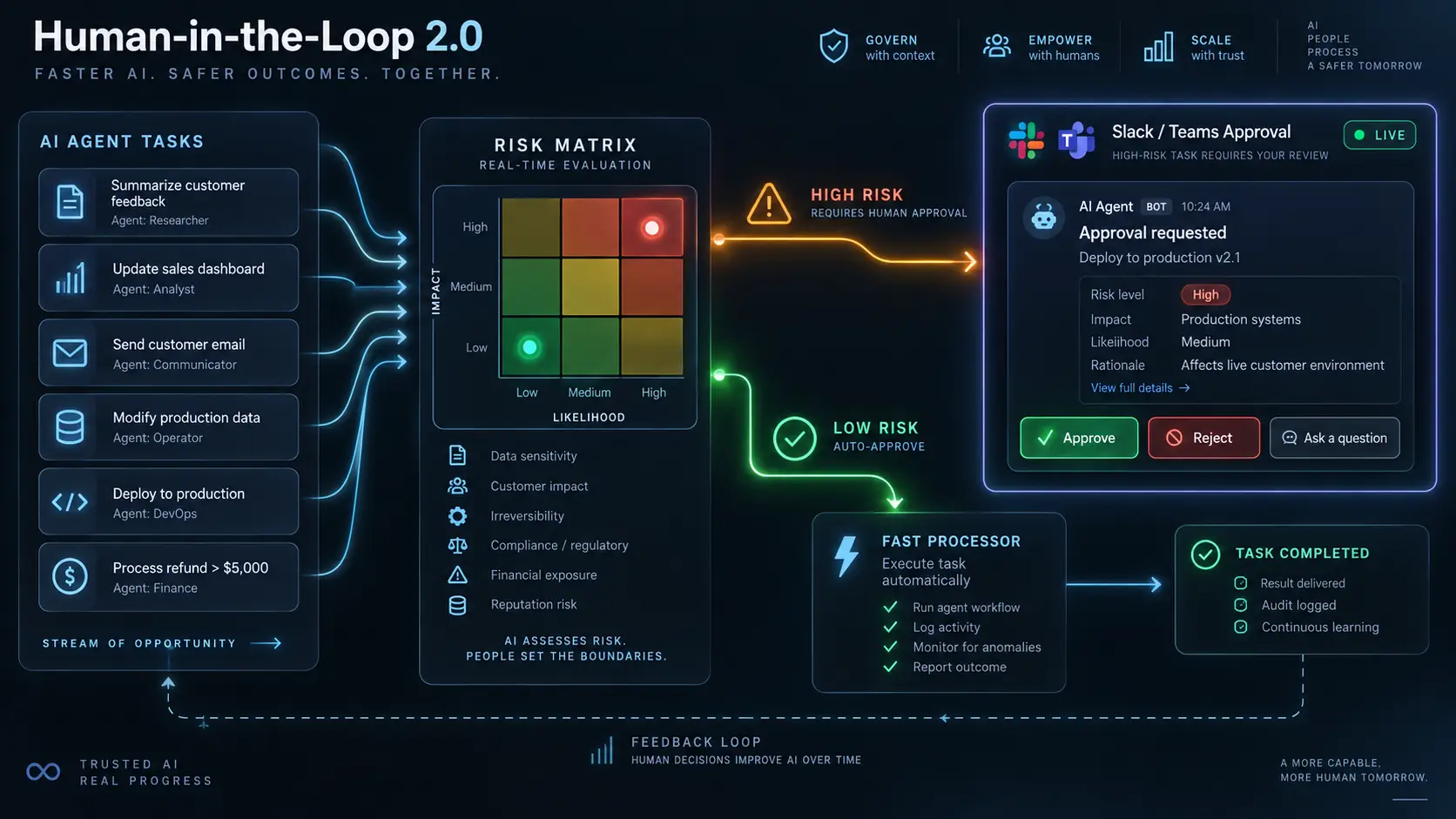
In 2026, the teams actually running agents in production have replaced blanket approval with Human-in-the-Loop 2.0: risk scoring, confidence thresholds and asynchronous escalation that reserve human attention for the decisions that genuinely need it.
HITL 1.0 vs HITL 2.0
| HITL 1.0 (legacy) | HITL 2.0 (modern) | |
|---|---|---|
| Approval scope | Every single action | High-risk or low-confidence actions only |
| Trigger mechanism | Hardcoded manual gate | Dynamic risk scoring and confidence thresholds |
| Interface | Separate admin portal | Inline async cards in Slack, Teams or email |
| Fallback strategy | Blocking queue, indefinite | Deterministic timeout, cancel or re-route |
| Failure mode | Approval fatigue, rubber-stamping | Fewer reviews, read properly |
The Escalation Ladder
The architecture is a ladder, not a gate. Each stage either releases the action or passes it down to the next.
┌────────────────────────────────────────────────────────┐
│                AGENT PROPOSES AN ACTION                │
└───────────────────────────┬────────────────────────────┘
                            ▼
┌────────────────────────────────────────────────────────┐
│  1. RISK MATRIX     blast radius · cost · reversible?  │
│                                                        │
│     Tier 1  read-only, idempotent ────────► EXECUTE    │
│     Tier 2  bounded value (refund < $100) ─┐           │
│     Tier 3  irreversible / high value ─────┴─┐         │
└──────────────────────────────────────────────┼─────────┘
                                               ▼
┌────────────────────────────────────────────────────────┐
│  2. CONFIDENCE FILTER                                  │
│                                                        │
│     Tier 2 and confidence ≥ 90% ──────────► EXECUTE    │
│     anything else ───────────────────────────┐         │
└──────────────────────────────────────────────┼─────────┘
                                               ▼
┌────────────────────────────────────────────────────────┐
│  3. ASYNC ESCALATION CARD (Slack / Teams / push)       │
│                                                        │
│     [ Approve ] [ Modify ] [ Reject ] ────► EXECUTE    │
│     no answer in 30 minutes ─────────────────┐         │
└──────────────────────────────────────────────┼─────────┘
                                               ▼
┌────────────────────────────────────────────────────────┐
│  4. TIMEOUT FALLBACK   cancel safely, or re-route to   │
│                        the on-shift secondary approver │
└────────────────────────────────────────────────────────┘
Every stage writes to the same audit log — including the automatic releases. An approval record that only captures human decisions cannot tell you whether the thresholds were set correctly.
1. The Action Risk Matrix
Not all agent actions carry equal risk. Reading a row from a customer database has effectively zero blast radius. Issuing a $5,000 refund or dropping a table does not.
HITL 2.0 sorts agent operations into three tiers, scored on blast radius, cost and reversibility:
- Tier 1 — auto-execute. Read-only queries, internal draft logging, idempotent API calls. No gate, ever.
- Tier 2 — conditional gate. Operations under a defined threshold (refunds below $100, a single record update) that execute automatically unless confidence drops.
- Tier 3 — hard gate. Irreversible or high-value operations — executing contracts, changing access permissions, anything touching a live customer environment. Always human sign-off, regardless of reported confidence.
The tiering belongs in the tool specification itself, not in a runbook nobody opens. This is the same discipline that makes an agent kill switch work when you need it: the boundary has to be enforced by the system, not remembered by a person.
2. Confidence Thresholds — With a Caveat
Rather than relying on static rules alone, the agent evaluates its own output before acting. A tool call generated with high confidence proceeds; ambiguity that drops confidence to the low seventies triggers an escalation card asking a human to verify.
One caveat that gets skipped, and shouldn't: a raw model probability is not a calibrated confidence score. A model reporting 90% is not correct 90% of the time by default. Before a threshold controls real execution, validate it against labelled outcomes on your own traffic, and re-validate after every model upgrade or prompt change — the same pre-production discipline covered in testing agents before they reach production.
An uncalibrated threshold is not a safety control. It is a number that makes everyone feel better.
3. Asynchronous Inline Escalation
Nobody wants to open another admin dashboard to unblock an agent. HITL 2.0 sends the decision into the tools people are already in — Slack, Microsoft Teams, mobile push.
A manager receives:
Agent #4 proposes a $450 customer credit adjustment. Confidence: 78% · Reason: vendor delay outside SLA
[ Approve ][ Modify amount ][ Reject ]
Approving inside Slack resolves the hold immediately, without a context switch. The card carries enough context to make the decision — the amount, the confidence, and the reason — because a card that forces the reviewer to go and look something up is just a dashboard with extra steps.
4. Timeouts and Fallback Routing
An escalation that sits unanswered must not leave the agent hanging. HITL 2.0 enforces a deterministic timeout — 30 minutes is a common default — with two possible outcomes:
- Fail-safe cancel. The action is cancelled cleanly, compensating transactions run, and the requester is notified. This depends on having a real rollback and recovery path; without one, "cancel" is a hope, not a guarantee.
- Re-route. The request escalates to a secondary approver or the team lead on shift.
Pick one per action tier and write it into the spec. The failure you are designing out is the silent one: an agent blocked at 4pm on a Friday that nobody notices until Monday.
What Changes When You Ship It
Teams that move from blanket approval to risk-triggered escalation see the same pattern of improvement:
- ⚡ Routine work stops queueing. Tier 1 and high-confidence Tier 2 actions execute at machine speed instead of waiting on a human login. This is where nearly all the latency was hiding.
- 🎯 Review quality goes up as review volume goes down. When a manager sees three escalations a day instead of ninety, they read them. Fewer approvals, taken seriously, beat a wall of rubber stamps.
- 🔒 The audit trail becomes useful. Logging every decision — automatic and human — turns governance into a feedback loop: you can see which thresholds are wrong and tune them, rather than guessing.
The honest caveat on all three: the size of the gain depends entirely on your traffic mix. If most of your agent's work is genuinely Tier 3, selective escalation will not speed much up — and that is a finding worth having before you build it.
Bottom Line
Real AI governance isn't standing in front of your agents with a stop sign. It's building guardrails precise enough that the agent can run fast inside them.
Blanket approval fails on both counts: it slows the agent down and degrades the human review it was supposed to guarantee. Selective escalation — risk-tiered, confidence-filtered, asynchronous, with a deterministic timeout — is what lets you keep compliance and still get the speed you bought the agents for.
Start by tiering your actions. Most teams discover that the overwhelming majority of what their agents do never needed a human at all, and that the handful that did were buried in the queue with everything else. Pair it with proper agent observability so you can see what the thresholds are actually doing in production.
Ready to modernise your agent governance?
Book a discovery call with Cynked to audit your current workflow guardrails, design risk-tiered escalation triggers, and build production agent systems that scale safely.
Need a scalable stack for your business?
Cynked designs cloud-first, modular architectures that grow with you.
Related Articles

The AI Agent Containment Gap: Why You Can't Shut Down a Rogue Agent
60% of enterprises can't quickly shut down a misbehaving AI agent. Here's the four-primitive containment architecture that closes the gap before an incident.

AI Agent Rollback & Recovery: A Production Playbook for 2026
When an AI agent takes the wrong action in production, can you undo it? A practical rollback and recovery playbook for enterprises running agents at scale.

AI Agent Observability: Monitoring Autonomous Systems in Production
AI agents run autonomously in production—but most enterprises can't see what they're doing. Here's how to build observability before regulators demand it.