
Most enterprises deploying AI agents in 2026 are flying blind. According to Deloitte's 2026 State of AI in the Enterprise, 58% of organizations say AI is now deeply embedded in operational and decision-making workflows—but only 19% have a complete governance framework in place. The gap between deployment and oversight is the single biggest risk in enterprise AI right now, and observability is the discipline that closes it.
This isn't an abstract concern. When an agent autonomously updates a customer record, files a support ticket, executes a refund, or queries a database, someone needs to be able to answer three questions later: What did it do? Why did it do that? And was it allowed to?
Why Traditional Monitoring Falls Short
Classic application performance monitoring (APM)—Datadog, New Relic, Dynatrace—was designed for deterministic systems. A function takes input X and returns output Y. When something breaks, you check the stack trace.
AI agents don't work that way. A single user request might trigger:
- 3-7 LLM calls across a reasoning loop
- Dynamic tool selection from a registry of 20+ functions
- Retrieval from a vector database with semantic ranking
- A downstream API call that mutates production data
If something goes wrong—wrong customer charged, sensitive data leaked, hallucinated answer sent to a regulator—the trace your APM captured shows you HTTP latency. It doesn't show you which prompt the agent constructed, what context it pulled, or why it picked the wrong tool.
What AI Agent Observability Actually Captures
A production-grade agent observability stack records four layers:
1. Prompts and completions. Every LLM call: the system prompt, user input, retrieved context, tool definitions, and full model response—including reasoning tokens where available. Without this, you cannot reproduce a bad decision after the fact.
2. Tool calls and side effects. Which functions the agent invoked, with what arguments, and what they returned. For agents touching production systems (CRM updates, database writes, payments), this becomes the audit trail.
3. Decision rationale. The chain-of-thought, sub-goals, and intermediate plans—especially in multi-agent setups where one agent delegates to another. This is what regulators will ask for.
4. Cost and latency telemetry. Token usage per request, per user, per workflow. Most enterprises discover their agent unit economics only after a surprise $40K monthly OpenAI bill.
The Tooling Landscape in 2026
The market has consolidated around a handful of viable platforms:
- LangSmith (LangChain) — the default if your agents are built on LangChain or LangGraph. Strong trace UI, weak access controls.
- Arize Phoenix — open-source, OpenTelemetry-native, framework-agnostic. Best fit if you want to self-host.
- Langfuse — open-source with a strong managed tier; popular with mid-market teams running custom agent stacks.
- Datadog LLM Observability — if you're already on Datadog, the integration story is smoothest, but the LLM-specific features lag the specialists.
- Microsoft Agent Governance Toolkit — released April 2, 2026, focused on runtime security and policy enforcement for agents in Azure environments.
For most mid-market enterprises, the pragmatic choice is Langfuse or Phoenix self-hosted, layered with Datadog for infrastructure metrics. Avoid building this in-house—we've seen three clients waste 4-6 months trying.
A Practical Implementation Sequence
If you have agents in production and no observability, here's the 30-day path we recommend:
Week 1: Instrument. Pick one platform. Wrap your LLM clients and tool functions with the SDK. Backfill is impossible, so start now—every day without instrumentation is an audit trail you can't recover.
Week 2: Baseline. Capture a week of production traffic. You will discover three things: agents using more tokens than estimated (typically 2-3x), an unexpected long-tail of failed tool calls, and at least one prompt injection attempt.
Week 3: Alerting. Set thresholds for: cost per session above 95th percentile, hallucination flags from your eval pipeline, repeated tool failures, and any access to sensitive data categories. Pipe alerts into your existing incident channel. Observability is only half of the story — pair it with a documented AI agent rollback and recovery playbook so the team has a defined response when those alerts fire on a production agent.
Week 4: Audit playback. Pick five real production sessions and have a non-technical stakeholder—legal, compliance, or a business owner—walk through them in the trace UI. If they can't follow what happened, your traces aren't detailed enough.
The Compliance Forcing Function
The EU AI Act's general application date of August 2, 2026 is no longer theoretical. High-risk AI systems—which now explicitly include many agent use cases in HR, credit, healthcare, and critical infrastructure—must maintain automatic event logs sufficient to enable post-market monitoring and traceability of decisions.
Colorado's AI Act takes effect June 30, 2026. ISO/IEC 42001 has emerged as the de facto enterprise AI management standard, and certification audits require demonstrable logging and oversight processes.
In other words: the same observability stack that helps your engineers debug agents is also the artifact your compliance team will hand to auditors. Build it once, use it twice.
What Good Looks Like
A well-observed agent deployment has four characteristics:
- Sub-second trace lookup for any user-reported incident, including full prompt/response chains.
- Cost dashboards broken down by agent, workflow, and customer—reviewed weekly by an accountable owner.
- Continuous evaluation running on a sample of production traces, scoring for hallucination, policy violations, and task completion.
- Human-readable audit reports that legal, compliance, or external auditors can interpret without engineering help.
If you can't produce these today, you don't have an agent governance problem—you have an observability problem masquerading as one.
Where to Start
The enterprises that scale agents successfully in 2026 will be the ones that treated observability as foundational infrastructure, not an afterthought. The ones that don't will face a choice between rolling back deployments or absorbing regulatory and reputational risk they didn't price in.
If you're running agents in production and aren't sure what they're doing, or you're planning a deployment and want to get the observability layer right from day one, Cynked helps mid-market and enterprise teams design, instrument, and govern agent stacks that hold up to internal audit and external regulation. Get in touch for a 30-minute review of your current setup.
Need a scalable stack for your business?
Cynked designs cloud-first, modular architectures that grow with you.
Related Articles
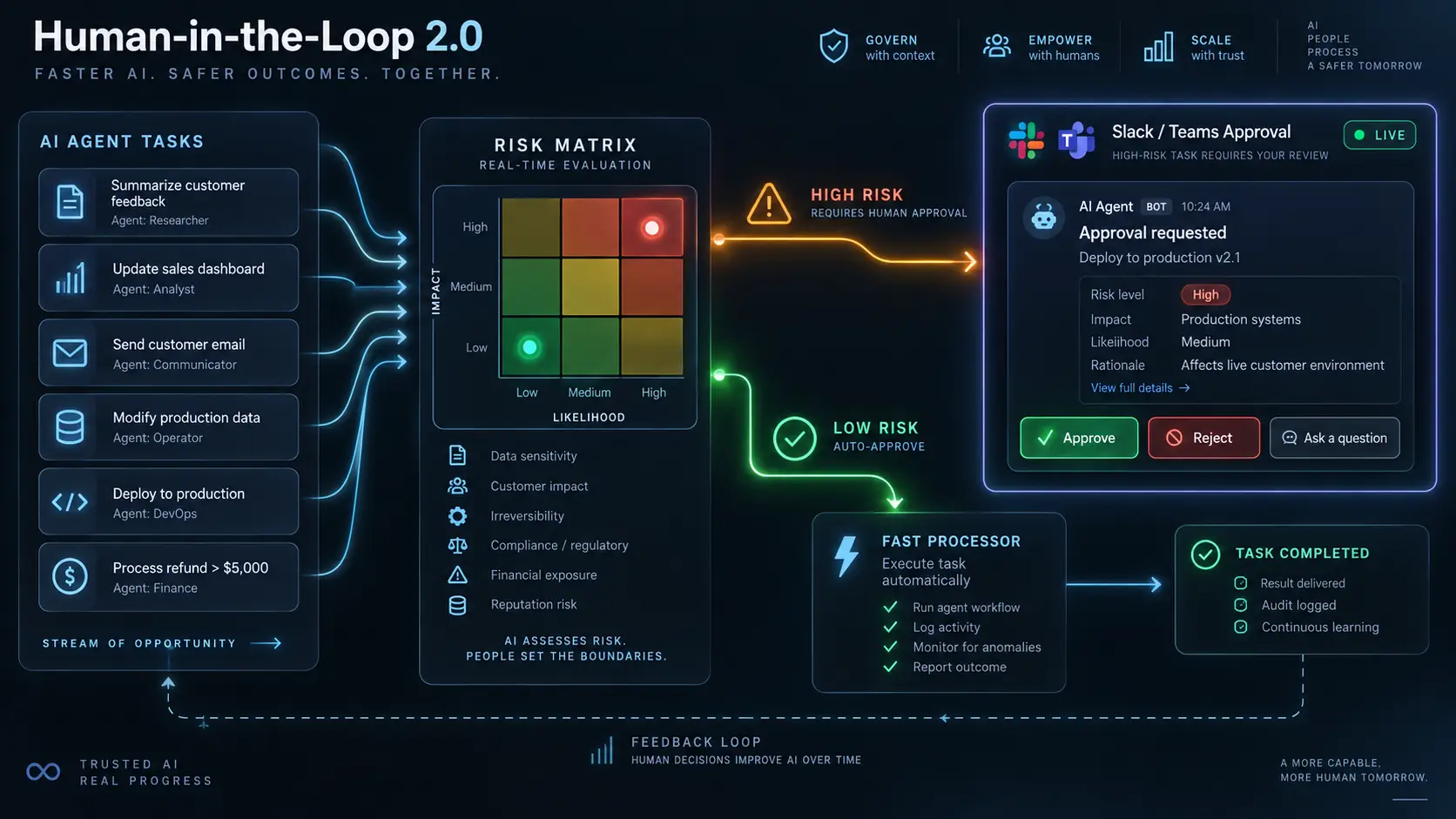
Human-in-the-Loop 2.0: Designing Escalation Triggers That Don't Bottleneck Agents
Requiring human approval for every agent action is not governance — it is a queue. Here is how risk scoring, confidence thresholds and async escalation keep agents fast and safe.

The AI Agent Containment Gap: Why You Can't Shut Down a Rogue Agent
60% of enterprises can't quickly shut down a misbehaving AI agent. Here's the four-primitive containment architecture that closes the gap before an incident.
AI Agent Rollback & Recovery: A Production Playbook for 2026
When an AI agent takes the wrong action in production, can you undo it? A practical rollback and recovery playbook for enterprises running agents at scale.