
Your AI agent just refunded $47,000 to a customer who wasn't entitled to it. Or it cancelled the wrong supplier contract. Or it sent an outreach campaign to a churned-customer list that should have been suppressed.
Now what?
In 2026, this scenario is no longer hypothetical. Nearly 97% of executives report deploying AI agents over the past year, and OpenAI says enterprise revenue is at a tipping point — agents are touching real systems, real customers, and real money. Yet most organizations have invested heavily in monitoring their agents and almost nothing in recovering from agent mistakes. That gap is becoming the single biggest reason production rollouts stall.
This post is a practical playbook for what to build before — not after — your first agent incident.
Why backup-and-restore doesn't work for agents
The instinct of most engineering leaders, when first confronted with the question "what if the agent does something wrong," is to fall back on database backups. That answer falls apart on first contact with reality.
A backup restores everything to a point in time. But during the window in which your agent acted, dozens or hundreds of other actors — humans, other agents, scheduled jobs — also wrote to the same systems. A point-in-time restore destroys their legitimate work alongside the agent's mistake. For customer-facing systems, it can also restore records the customer has since updated themselves, creating fresh data integrity issues.
Agent rollback needs to be surgical. It needs to unwind one specific decision while preserving everything around it. That requires architecture, not a backup script.
The four-layer rollback stack
In production deployments at mid-market and enterprise teams, a workable rollback architecture has four layers:
1. Reversible action design
Every action an agent can take must be classified as reversible, conditionally reversible, or irreversible. A database update is reversible. A refund is conditionally reversible (until the customer withdraws funds). An outbound email is irreversible. Build this classification into your agent's tool registry — not as documentation, but as code. Each tool should declare its reversibility class and, if reversible, its inverse operation.
2. Immutable action logs
Every agent action writes to an append-only log capturing: the agent ID, the reasoning chain, the inputs, the tool called, the parameters, the result, and a correlation ID linking it to upstream business events. This is not the same as observability tracing — observability tells you what happened performance-wise (and building agent observability before regulators demand it is a discipline in its own right); the action log is the legal and operational source of truth for what the agent did.
3. Compensating transactions
For reversible and conditionally reversible actions, the agent framework should generate a compensating transaction at the moment of action. If the agent issues a refund, the framework simultaneously stages a "reverse refund" transaction that can be triggered without rerunning the agent. This is the saga pattern adapted for AI — a 1980s idea that turns out to be exactly right for 2026 agent architectures.
4. The supervisor and the kill-switch
Above the operational agents, a supervisor agent (or rules engine) audits decisions on a delay — typically 5 to 60 minutes — and can trigger rollback automatically when confidence scores drop below a threshold or when actions violate policies. Underneath everything, a manual kill-switch lets a human pause an entire fleet of agents within seconds, while preserving the action log for forensics.
What good triggers look like
The hardest design question isn't how to roll back — it's when. Teams that have shipped agents to production successfully use a combination of signals:
- Pre-action guardrails: hard policy checks that block irreversible actions above a value threshold (e.g., refunds over $500) without human approval
- Post-action sampling: a supervisor agent re-evaluates 5–10% of actions and flags divergence from policy
- Customer-channel signals: spikes in specific complaint patterns automatically pause the responsible agent
- Drift detection: shifts in the distribution of agent decisions trigger review even without explicit failures
The rule of thumb I give clients: if an action costs more than $1,000 to reverse and the agent's confidence is below 0.85, route it to a human. Tune from there.
A 30-day implementation path
For a mid-market team running its first production agent, a realistic rollout looks like:
Week 1: Audit existing agent tools. Classify each as reversible / conditionally reversible / irreversible. Add a hard human approval gate on every irreversible action above your defined value threshold.
Week 2: Stand up an immutable action log. Most teams use an append-only Postgres table with a separate replica, or a managed event store like AWS QLDB. Wire every tool call through it.
Week 3: For your top three reversible action types, build the compensating transaction explicitly. Test the rollback path in staging with synthetic incidents.
Week 4: Deploy a supervisor process — even a simple rules engine is enough to start — that samples actions and can trigger compensations. Run a tabletop incident exercise with the team.
This is roughly the engineering effort of a small feature, not a transformation program. The cost of skipping it is the cost of your first incident, which industry surveys put at six-figure damages for typical mid-market agent deployments — before reputational impact.
What this unlocks
The organizations that have built rollback infrastructure aren't just safer. They ship faster. When teams trust they can recover from agent mistakes, they expand agent scope more aggressively. Risk-averse leaders stop blocking deployments. Compliance and legal sign off on use cases that would otherwise sit in pilot indefinitely.
In other words: rollback infrastructure is what moves agents from the 12% production rate that's typical today to the 60–70% rate that early leaders have already reached.
Get this right before your first incident
Cynked helps mid-market and enterprise teams design AI agent architectures that survive production — including rollback, supervisor patterns, and incident playbooks. If you're rolling out an agent in the next 90 days, reach out for a working session before you ship.
Need a scalable stack for your business?
Cynked designs cloud-first, modular architectures that grow with you.
Related Articles
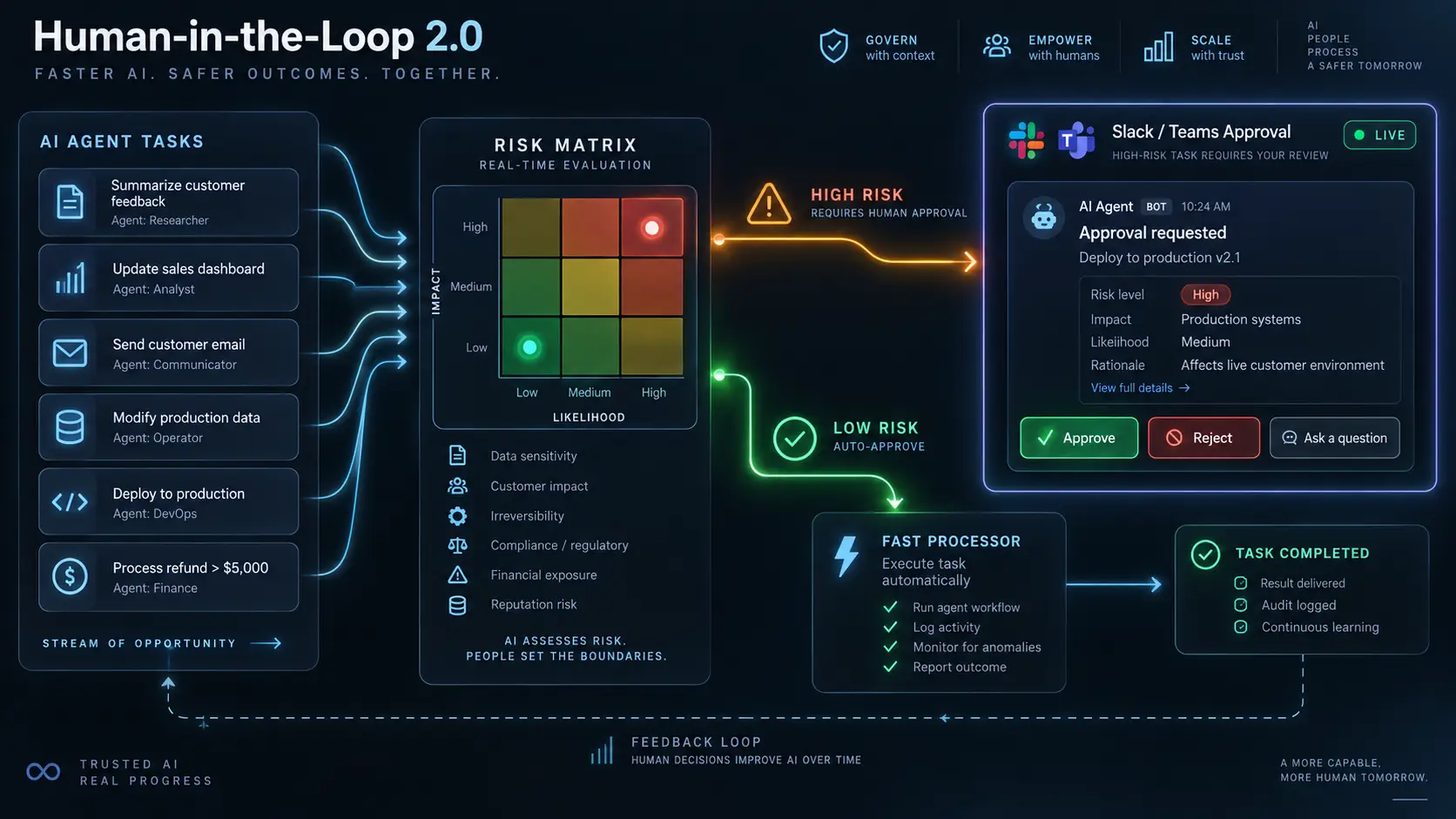
Human-in-the-Loop 2.0: Designing Escalation Triggers That Don't Bottleneck Agents
Requiring human approval for every agent action is not governance — it is a queue. Here is how risk scoring, confidence thresholds and async escalation keep agents fast and safe.

The AI Agent Containment Gap: Why You Can't Shut Down a Rogue Agent
60% of enterprises can't quickly shut down a misbehaving AI agent. Here's the four-primitive containment architecture that closes the gap before an incident.

AI Agent Observability: Monitoring Autonomous Systems in Production
AI agents run autonomously in production—but most enterprises can't see what they're doing. Here's how to build observability before regulators demand it.