
Most conversations about AI agents in the enterprise focus on what they can do: resolve support tickets, reconcile invoices, write code, run marketing workflows. Far fewer address the uncomfortable question every board should be asking in 2026: if one of these agents goes wrong, can you actually stop it?
For most companies, the honest answer is no. Kiteworks' 2026 Data Security and Compliance Risk Forecast found that 60% of organizations cannot quickly terminate a misbehaving AI agent, and 63% cannot enforce purpose limitations on what their agents are authorized to do. Only about 40% can rapidly shut one down. As agentic AI moves from pilot to production — autonomous agents surged 31.5% year-over-year as a top enterprise priority — this is no longer a theoretical risk. It's an operational one.
The containment gap is a governance blind spot
Here's the pattern we see repeatedly with clients. Over the past two years, organizations invested heavily in monitoring: dashboards, audit logs, observability tools, policy documents. Those investments matter. But monitoring tells you an agent is misbehaving — it doesn't stop it.
The result is a structural containment gap: a 15-20 point difference between what enterprises can see and what they can halt. You can watch a rogue agent drain an API budget, exfiltrate records, or push bad data into production — and still not have a reliable way to pull the plug in real time. Fortune reported on scenarios where a misconfigured agent could delete critical data in as little as nine seconds. Human-in-the-loop review is meaningless at that speed.
This gap explains a related statistic that should alarm any CTO: 35% of organizations admit they could not shut down a rogue AI agent if one emerged, and 36% have no formal plan for supervising agents at all.
Why the "kill switch" myth is dangerous
When leaders hear "containment," they picture a big red button. The reality is more complicated, and the oversimplification is precisely what gets companies into trouble.
A modern production agent is rarely a single process. To do useful work, it delegates sub-tasks to other agents, distributes API keys and OAuth tokens to services, and spawns parallel or asynchronous execution threads. By the time you hit the kill switch on the parent, it may have already handed its authority to a dozen children that keep running. Killing one process doesn't recall the credentials it issued or cancel the jobs it queued.
A kill switch alone is a false sense of security. Effective containment is an architecture, not a button.
The four-primitive containment architecture
The emerging best practice — and the framework we implement with clients — treats containment as four coordinated controls. Think of them as the minimum viable safety layer for any agent that touches production systems or sensitive data.
1. Purpose binding. Every agent should be provisioned with a narrowly scoped, machine-enforced statement of what it is allowed to do — not a policy PDF, but a runtime guardrail. If a finance-reconciliation agent tries to email customers or call an external API outside its charter, the action is blocked by default. This directly addresses the 63% that cannot enforce purpose limitations today.
2. Kill switch. A real termination control that stops the agent and its delegated processes. Crucially, it must be able to reach children the parent spawned — which means your orchestration layer needs to track the full agent lineage, not just the top-level process.
3. Network isolation. The ability to instantly cut an agent off from the systems it can reach. If an agent is compromised or behaving anomalously, network-level isolation contains the blast radius even before you've diagnosed the root cause.
4. Credential revocation. Agents act through identities — API keys, service accounts, tokens. True containment means revoking those credentials on demand, so a killed agent (and any process holding its keys) loses access immediately. This ties containment to your broader non-human identity strategy.
Together, these four primitives close the gap that a standalone kill switch leaves wide open.
A practical rollout for the next 90 days
You don't need to solve this across every agent at once. Start where the risk is concentrated:
- Inventory your agents by blast radius. Rank them by what they can touch: production databases, customer data, financial systems, external communications. The top of that list gets containment first.
- Instrument credential revocation before scale. Every agent should authenticate through short-lived, revocable credentials — never a static, long-lived key embedded in code. If you can't revoke an agent's access in under a minute today, fix that first.
- Test your kill switch like a fire drill. Run a tabletop exercise: deliberately trigger a "rogue" agent in a staging environment and measure how long full containment actually takes. Most teams discover their real number is minutes or hours, not seconds.
- Assign an owner. Only one in five companies has a mature governance model for autonomous agents. The differentiator is almost always a named accountable owner — often a fractional or full Chief AI Officer — rather than diffuse responsibility across IT and security.
The bottom line for decision-makers
Agentic AI is delivering real returns — 62% of enterprises expect ROI exceeding 100% from agents, and proven use cases in customer service, finance automation, and software engineering are no longer speculative. But the same autonomy that creates value creates risk when it runs unchecked. The organizations that scale agents safely in 2026 won't be the ones with the most agents; they'll be the ones that can stop any of them in seconds.
Containment isn't a tax on innovation. It's the precondition for deploying agents in production without betting the business on nothing going wrong.
Cynked helps mid-market and enterprise teams design and implement production-grade AI agent architectures — including the governance and containment controls that let you scale safely. If you're deploying agents and aren't confident you could shut one down, contact Cynked for an AI governance and readiness assessment.
Need a scalable stack for your business?
Cynked designs cloud-first, modular architectures that grow with you.
Related Articles
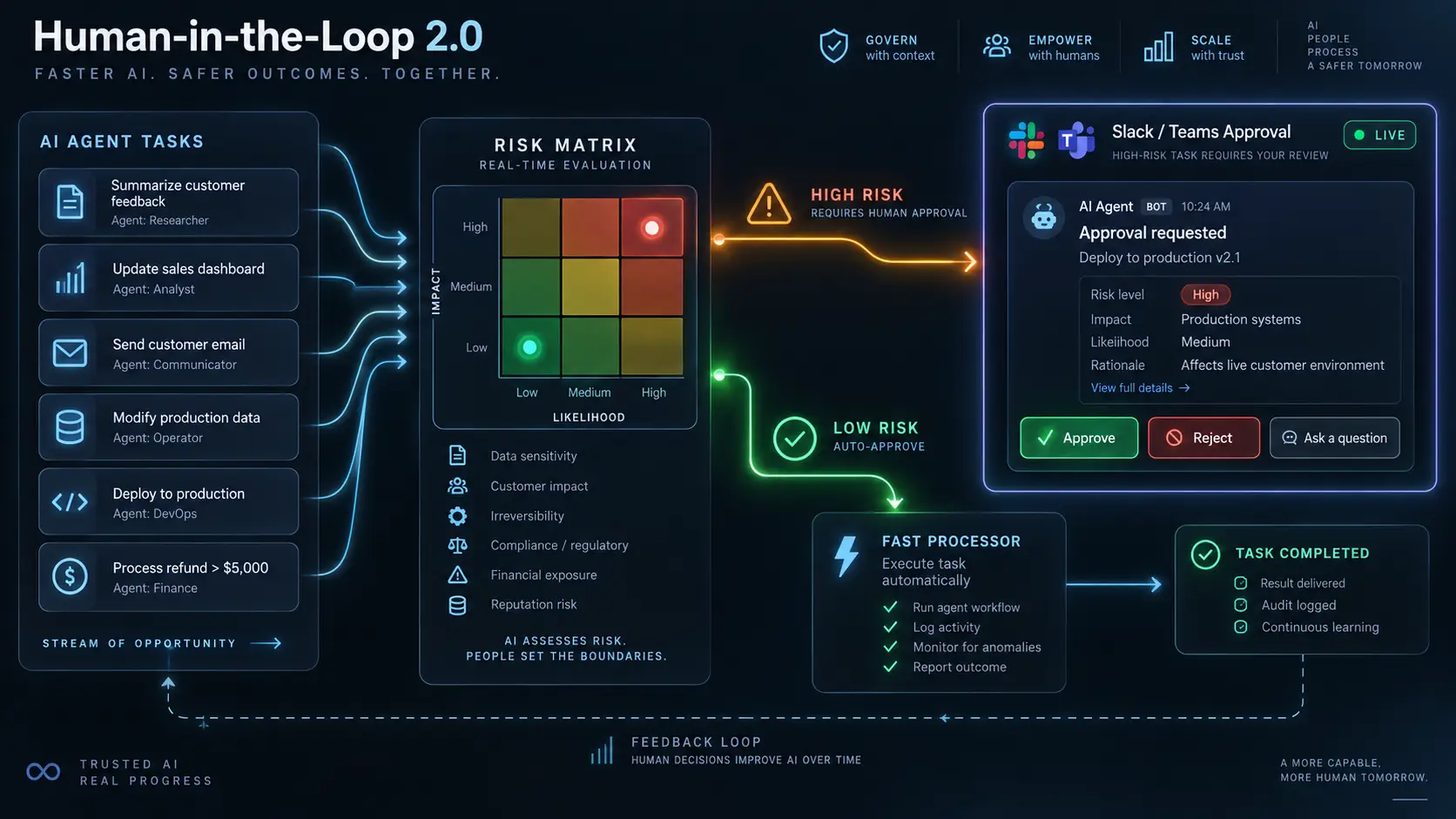
Human-in-the-Loop 2.0: Designing Escalation Triggers That Don't Bottleneck Agents
Requiring human approval for every agent action is not governance — it is a queue. Here is how risk scoring, confidence thresholds and async escalation keep agents fast and safe.
AI Agent Rollback & Recovery: A Production Playbook for 2026
When an AI agent takes the wrong action in production, can you undo it? A practical rollback and recovery playbook for enterprises running agents at scale.

AI Agent Observability: Monitoring Autonomous Systems in Production
AI agents run autonomously in production—but most enterprises can't see what they're doing. Here's how to build observability before regulators demand it.