

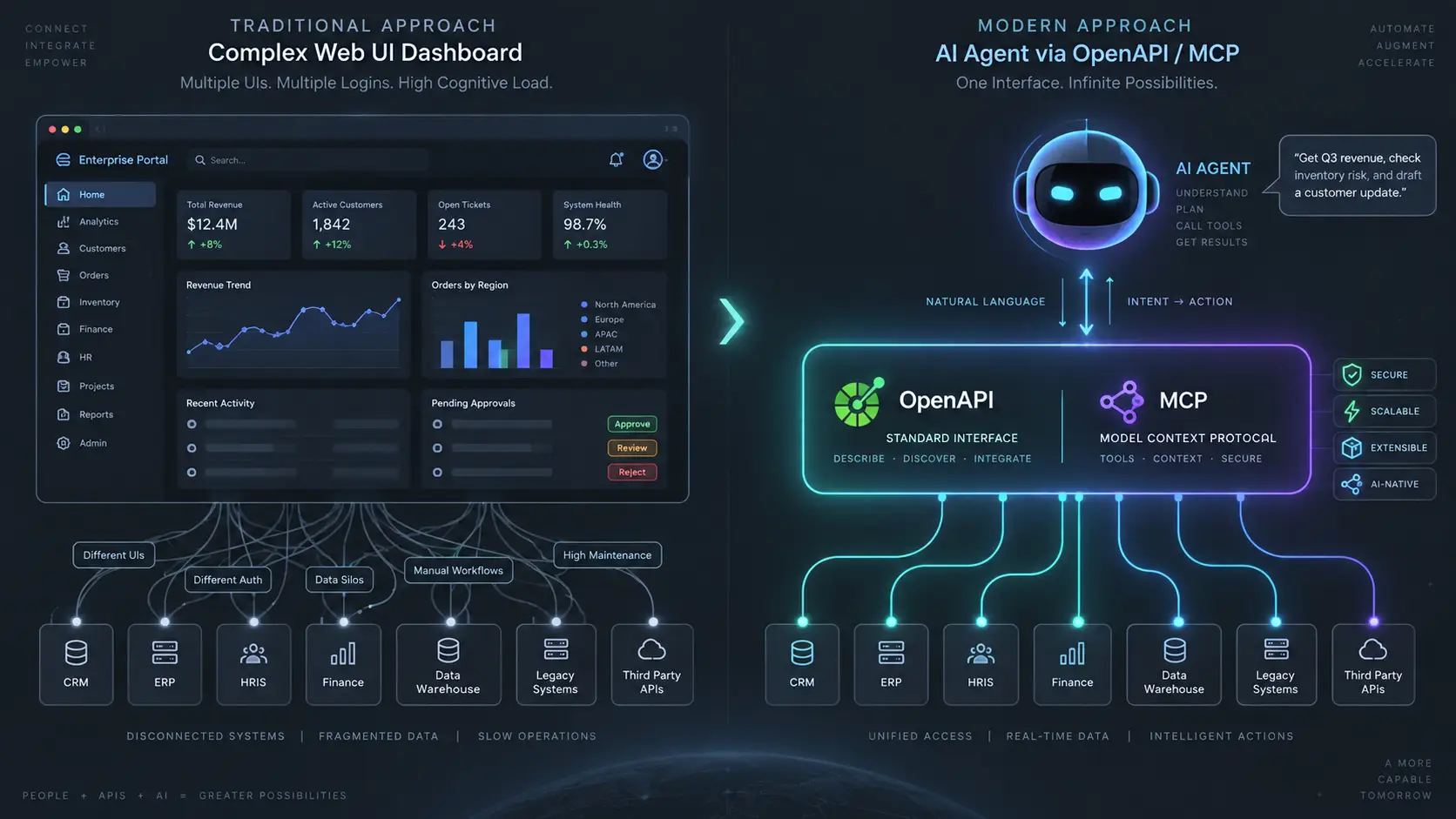
For thirty years, enterprise software architecture was designed around a single fundamental assumption: a human being would be sitting in front of a browser, clicking buttons.
We built complex dashboards, multi-step checkout forms, and elaborate navigation menus. Backend APIs were designed primarily to hydrate frontend UI components or power rigid, pre-programmed system integrations.
In 2026, that assumption is dead.
Today, the fastest-growing consumer of enterprise backend systems isn't a human user clicking through a web app — it's an autonomous AI agent.
When an AI agent executes a workflow (reconciling invoices, provisioning cloud infrastructure, or routing customer refunds), it doesn't navigate your web app's UI. It interacts directly with your backend endpoints via tool calls, OpenAPI definitions, and Model Context Protocol (MCP) servers.
If your APIs were built solely for traditional web apps, your software is becoming invisible — and unreliable — to the next generation of automated business workflows.
Here is why agent-native APIs are the new enterprise competitive advantage, and how to redesign your backend architecture for autonomous model consumption.
The Core Problem: Why Traditional REST APIs Fail AI Agents
Traditional REST APIs were built for deterministic software integrations where human developers hardcoded every request payload. When an AI agent attempts to use those endpoints via tool calling, three structural flaws emerge.
1. Ambiguous Schemas
Standard Swagger/OpenAPI files often lack explicit semantic descriptions for parameters. A parameter named status_code: int tells a human developer enough, but leaves a model guessing what values are valid — 1, 200, or "ACTIVE"?
2. Side-Effect Risk Without Idempotency
If an agent hits a timeout during a POST call, it will naturally retry. Without built-in idempotency keys, an agent retrying an order placement endpoint creates duplicate billing events. This is the same class of failure that makes a documented rollback and recovery playbook essential once agents touch production systems.
3. Payload Bloat
Traditional endpoints return massive JSON objects containing hundreds of nested fields designed for UI rendering. Passing those raw payloads into a model's context window burns thousands of unnecessary tokens per call, driving up latency and cost — the context window bloat problem, arriving through your own API layer.
The 4 Principles of Agent-Native API Architecture
Leading engineering teams aren't rebuilding their entire backend. They are building an agent-native API layer that sits between frontier models and enterprise core services.
┌────────────────────────────────────────────────────────┐
│                   Autonomous AI Agent                  │
└───────────────────────────┬────────────────────────────┘
                            │ (Tool calls via MCP / OpenAPI)
                            ▼
┌────────────────────────────────────────────────────────┐
│                AGENT-NATIVE API LAYER                  │
├────────────────────────────────────────────────────────┤
│ 1. Rich Semantic Parameter Descriptions                │
│ 2. Idempotency & Reversibility Guards                  │
│ 3. Minified Payload Summarizers (Token-Lean)           │
│ 4. Dedicated Agent Rate Limiting & Isolation           │
└───────────────────────────┬────────────────────────────┘
                            │ (Deterministic REST calls)
                            ▼
┌────────────────────────────────────────────────────────┐
│             Enterprise Core Microservices              │
└────────────────────────────────────────────────────────┘
1. Semantic-First Schema Definitions (MCP & OpenAPI 3.1)
An agent-native API treats parameter documentation as executable code. Every endpoint schema should provide explicit intent, constraints, and examples directly in the field descriptions.
Traditional schema:
"customer_id": { "type": "string" }Agent-native schema:
"customer_id": {
  "type": "string",
  "description": "Unique 12-digit UUID for the account holder. Example: 'usr_98a72b11'. Do NOT use email or username here."
}
The negative constraint — "Do NOT use email here" — does most of the work. Explicit exclusions are the single cheapest way to cut tool invocation errors, because they remove the plausible-but-wrong option the model would otherwise reach for.
2. Mandatory Idempotency and Action Classification
Every state-modifying endpoint exposed to an agent should accept an Idempotency-Key header. When an agent retries an execution step after network jitter, the backend guarantees the action runs exactly once.
Agent-native APIs also classify actions into three safety tiers:
- Idempotent / read-only — safe for immediate execution (e.g. fetching account metrics).
- Undoable / saga-backed — safe to execute immediately because compensating transactions exist.
- Approval-gated — requires a human-in-the-loop token before the backend will process the payload.
That classification is what lets you grant an agent real authority without granting it unlimited blast radius. It belongs in the spec, not in a runbook.
3. Payload Minification and Markdown Projections
Never send raw UI-focused JSON back to an agent. An agent-native layer uses projection transformers to strip syntax clutter — curly braces, null fields, repeated keys — and returns lean markdown tables or key-value pairs instead.
A response designed for a React component and a response designed for a model are two different products. Build both.
4. Dedicated Agent Rate Limiting and Isolation
AI agents generate traffic in non-human patterns — sometimes 50 API calls in three seconds during a single reasoning loop. Traditional IP-based or session-based rate limiters will either block legitimate agent traffic outright or, worse, let a looping agent overwhelm production microservices.
Agent-native APIs use token-bucket rate limiters scoped per agent run, and isolate agent traffic into dedicated worker pools behind circuit breakers. This is the same isolation discipline that separates a secure agent integration from an open door into your core systems.
Realistic Results: What Upgrading Your API Layer Achieves
When teams deploy an agent-native wrapper over existing services, the operational improvements show up quickly:
- 🎯 Sharply higher tool-calling reliability — semantic schemas and explicit constraints remove most parameter hallucination and malformed payloads.
- 🛡️ No duplicate side effects — idempotency keys eliminate double-billing and duplicate ticket creation on retries.
- ⚡ Materially lower token overhead — minified projections keep context windows fast and cost-effective, often cutting response payload tokens by more than half.
Bottom Line
Your website UI is for human customers. Your API schemas are for your AI workforce.
As agents take over operational workflows, the advantage belongs to companies whose systems can be commanded safely, quickly, and deterministically by a model. That is a design decision, and right now most backends have not made it.
Is your backend infrastructure ready for the AI agent transition?
Book a discovery call with Cynked to audit your current API specs, implement Model Context Protocol (MCP) integrations, and build an agent-native architecture that scales.
Need a scalable stack for your business?
Cynked designs cloud-first, modular architectures that grow with you.
Related Articles

AI Agents in the Enterprise: Where to Start and What to Avoid
AI agents can automate complex multi-step workflows — but deployed in the wrong place, they create new problems. Here is a practical framework for enterprise leaders deciding where to start.

How AI Agents Are Automating Business Operations Right Now
Discover how agentic AI is transforming business operations in 2026 with real use cases in customer support, supply chains, and workflow orchestration.

AI Agents Explained: What Business Owners Need to Know
AI agents are reshaping how businesses operate. Learn what they are, how they differ from chatbots, and whether your business is ready to adopt them.