
Most AI agent projects don't fail because the model isn't smart enough. They fail because nobody could tell whether the agent was working. In LangChain's 2026 State of AI Agents survey, 57% of organizations now have agents in production — and one in three respondents named quality as their single biggest barrier to getting there, with latency a close second at 20%. Separate field data is even blunter: roughly 22% of enterprise agent deployments show negative ROI at the 12-month mark, and 41% of those failures trace back to unclear success criteria or eroding evaluation coverage.
The lesson for CTOs and operations leaders is uncomfortable but useful: the agent isn't the hard part — knowing it's good enough is. It's also a big reason only about 12% of AI agents ever reach production: the teams that get there share a short list of disciplines, and a trustworthy evaluation pipeline is chief among them. This guide walks through how to build that capability before you ship.
Why "it worked when I tried it" isn't a test
Traditional software is deterministic. Same input, same output, and a unit test that asserts expect(result).toBe(42). Agents break all three assumptions:
- Non-deterministic outputs. The same prompt can produce different (both valid) answers, so exact-match assertions are useless.
- Multi-step trajectories. A support agent might call a CRM lookup, then a knowledge-base search, then draft a reply. Any step can go wrong while the final answer still looks plausible.
- Tool use and side effects. An agent that issues a refund or updates a ticket has real-world consequences if it picks the wrong tool or the wrong arguments.
"Vibe checks" — a product manager trying ten prompts and declaring victory — catch none of this. You need graded, repeatable evaluation across four layers.
The four layers of agent evaluation
1. Component evals. Test the pieces in isolation: does retrieval return the right documents? Does the router pick the right sub-agent? Does a single tool call have the correct arguments? These are fast, cheap, and catch the majority of regressions.
2. Trajectory (trace) evals. Look at the path the agent took, not just the destination. Did it call tools in a sensible order? Did it loop unnecessarily and burn tokens? Did it skip a required step? Trace-level scoring is where you catch the "right answer for the wrong reasons" failures that blow up later.
3. End-to-end task evals. Run the whole agent against a curated set of realistic tasks and grade the final outcome on task success, faithfulness to source data, tone/policy adherence, latency, and cost-per-task. This is your release gate. For agents that depend on retrieval, this layer is where the gap between demo and production tends to show up.
4. Online (production) evals. Once live, sample real traffic continuously and score it the same way. This is how you catch drift — a model update, a changed data source, a new edge case — before customers file complaints. Many teams run online evals on a 5-minute cadence and alert on score drops.
A practical build sequence
Step 1 — Build a golden dataset. Collect 50–100 representative tasks to start (real queries beat synthetic ones), each with an expected outcome or rubric. Heavily weight cases that have already caused problems. Grow toward 200–500 examples for a production-ready system, and add every production failure back into the set. This dataset is the single highest-leverage artifact you'll create.
Step 2 — Define metrics that map to business value. Pick 3–5: task success rate, tool-call accuracy, groundedness/faithfulness, policy adherence, p95 latency, and cost per resolved task. If a metric wouldn't change a go/no-go decision, drop it.
Step 3 — Use LLM-as-judge carefully. A second model can grade outputs at scale, but it's not free of bias and will occasionally hallucinate a grade. Validate the judge against human labels first — a 75–90% agreement rate means it's ready to scale. Feed it the right context (a faithfulness judge needs the retrieved documents), and treat a 100% pass rate as a red flag that your eval set is too easy, not a trophy. Lightweight specialized judge models (sub-200ms, far cheaper than frontier-model judges) are now a realistic option for high-volume scoring.
Step 4 — Wire evals into CI. Run offline evals automatically on every change to a prompt, tool, retrieval config, or model version, and block the merge if scores regress past a threshold. This is the difference between "we tested it once" and "it stays tested."
Step 5 — Turn on online evals and drift alerts. Sample live traffic, score it, chart it, and page the agent owner when quality, latency, or cost moves the wrong way.
The 2026 tooling landscape — a quick orientation
You don't need to build this from scratch. The platforms enterprises actually use today:
- LangSmith — tightest fit if you're building on LangChain/LangGraph; strong tracing, datasets, and CI integration.
- Langfuse and Arize Phoenix — open-source tracing and evals; good starting points that keep data in your environment.
- Maxim AI — end-to-end simulation, evals, and observability with session/trace/span-level scoring, plus SOC 2, HIPAA, and GDPR options and in-VPC deployment for regulated workloads.
- Galileo — evaluation with real-time guardrails and a fast in-house judge model.
- DeepEval — a Pytest-style library if your engineers want evals to feel like ordinary tests.
Gartner expects 60% of software engineering teams to adopt AI evaluation and observability platforms by 2028, up from about 18% in 2025 — so this is becoming standard infrastructure, not a nice-to-have.
Common mistakes that quietly kill agent projects
- No golden dataset — you're flying blind and can't prove improvement.
- Vibes-based release decisions — no documented threshold means no accountability.
- Ignoring cost and latency — a "high quality" agent that takes 40 seconds and costs $0.80 a task may be a net negative.
- No human review loop — LLM judges drift too; spot-check a sample weekly.
- No versioning — if you can't tie a score to a specific prompt + model + tool config, you can't debug a regression.
- No named owner — someone needs to own the eval suite, the thresholds, and the pager. Organizations with a named agent owner convert pilots to production at roughly 2.7x the rate of those without one.
- Buying a rebranded chatbot instead of a real agent — even the best eval pipeline can't save you if the underlying platform was never agentic to begin with. Use our agent-washing buyer's framework during vendor selection so the agent that lands in your eval harness is actually worth testing.
Actionable takeaways
- Before you scale any agent, assemble a 50–100 example golden dataset weighted toward known failure cases.
- Pick 3–5 metrics tied to business outcomes — including cost and latency, not just "quality."
- Validate any LLM-as-judge against human labels (target 75–90% agreement) before trusting it.
- Make offline evals a CI gate; make online evals a continuous production check with drift alerts.
- Name one accountable agent owner who controls the thresholds and gets paged.
If your team is moving an AI agent toward production and you don't yet have an evaluation pipeline you trust, that's exactly the gap to close first. Cynked helps companies design and stand up agent evaluation, observability, and governance frameworks — and pick the right tooling for your stack and compliance needs. Get in touch for a working session on making your AI agents measurably reliable before they go live.
Further reading from FreeAcademy: How to evaluate AI agents: metrics, benchmarks and testing in 2026 is the deep technical companion to the eval framework above. What are AI agents and how do they work? (Simple explanation) and AI for beginners: 10 core concepts to understand before you start (2026) are good baseline reads for stakeholders signing off on go/no-go. How to use AI agents in your daily workflow (2026 guide) and agentic RAG: how AI agents supercharge retrieval in 2026 cover the workflow and retrieval patterns most enterprise agents are built on, while LangChain functions, tools, and agents: practical guide 2026 is the framework reference your engineers will reach for during eval design. And for power users running heavy eval workloads, Is Claude Max worth it in 2026? Real review of the $100 and $200 plans is a useful plan comparison.
Need a scalable stack for your business?
Cynked designs cloud-first, modular architectures that grow with you.
Related Articles

Agent Washing in 2026: How to Spot Fake AI Agents Before You Buy
Gartner says only ~130 of thousands of vendors selling 'AI agents' are genuinely agentic. Use this 7-point evaluation framework to avoid agent-washing traps.

Your Wrist Is Smarter Than You Think: AI on the Galaxy Watch 8 Classic
Galaxy AI and Google Gemini are built into the Samsung Galaxy Watch 8 Classic, but most owners barely scratch the surface. Here is what is live now, what One UI 9 Watch adds, and how to actually use it.
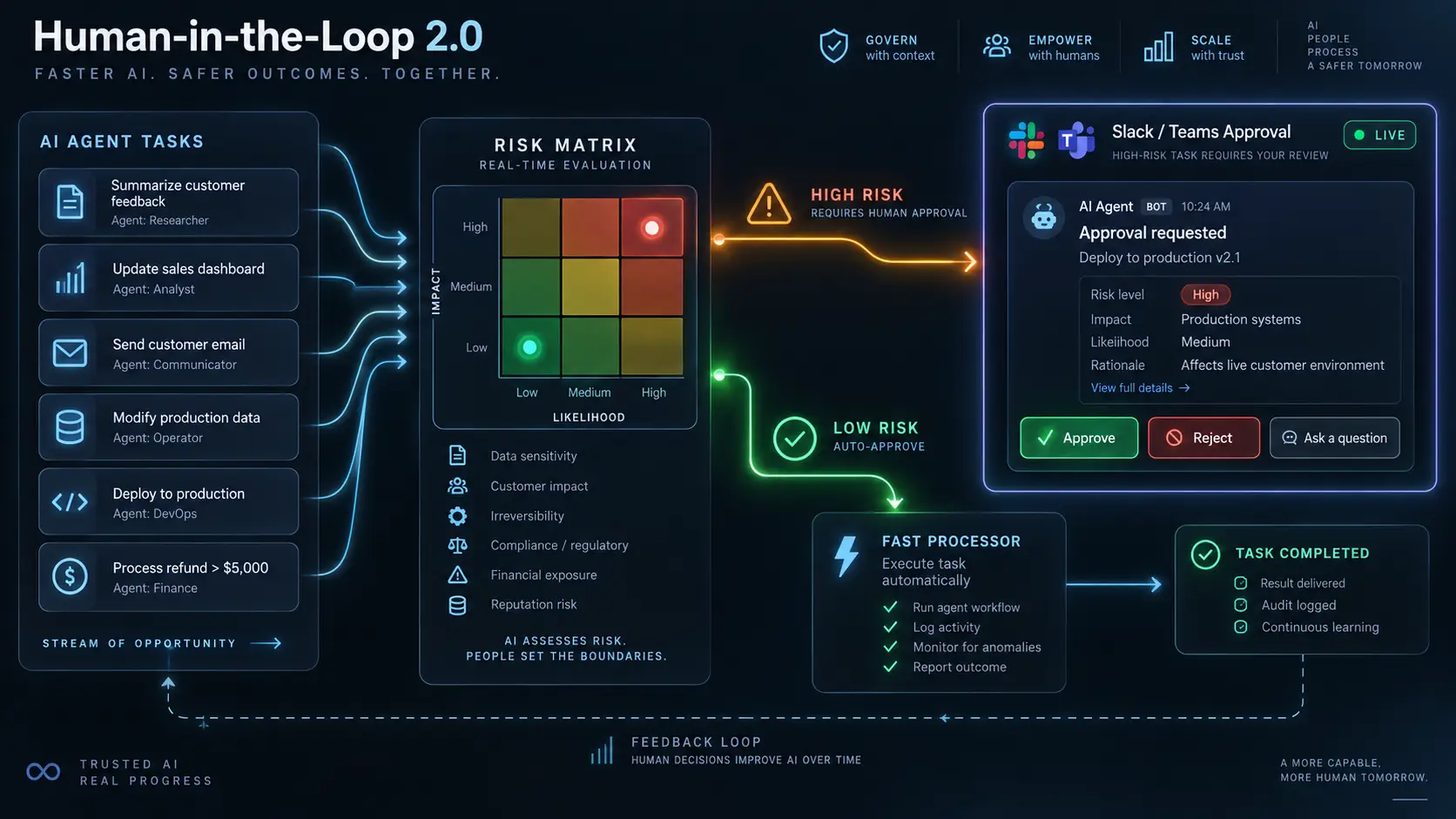
Human-in-the-Loop 2.0: Designing Escalation Triggers That Don't Bottleneck Agents
Requiring human approval for every agent action is not governance — it is a queue. Here is how risk scoring, confidence thresholds and async escalation keep agents fast and safe.