
In April 2026, OutSystems published research that landed like a warning shot across the enterprise: 94% of organizations now say AI sprawl is increasing complexity, technical debt, and security risk. That number has climbed sharply over the last year as agentic AI moved from pilot to production. According to Gartner, 40% of enterprise applications will include task-specific AI agents by year-end, up from less than 5% in 2025.
The paradox is sharp. Enterprises are spending more on AI than ever — worldwide AI spending is forecast at $2.52 trillion in 2026, up 44% from 2025 — yet 79% of organizations report mounting challenges scaling it. The problem is no longer access to AI. It is the chaos of having too much of it, deployed by too many teams, with no shared spine.
What AI Sprawl Actually Looks Like
AI sprawl is not the same as shadow AI. Shadow AI is unsanctioned use — an employee pasting customer data into a personal ChatGPT account. Sprawl is sanctioned chaos. It looks like this:
- Marketing has Jasper, Writer, and three custom GPTs running on ChatGPT Team
- Sales is paying for Gong, Clari Copilot, and Salesforce Einstein simultaneously
- Engineering has Copilot, Cursor, Claude Code, and an internal RAG chatbot
- Operations deployed five Microsoft Copilot Studio agents that nobody owns
- Legal subscribed to Harvey but the contract review team uses Spellbook
Every one of these was approved. Each solved a real problem. Together, they produce duplicated spend, fragmented governance, conflicting outputs, and a security perimeter that no CISO can reasonably defend.
The OutSystems data shows the cost: organizations with high sprawl scores spend 2.3x more on AI per employee than peers with consolidated stacks — for measurably worse outcomes on adoption and reliability.
Why Sprawl Exploded in 2026
Three shifts converged this year.
Agents became cheap to build. The April 2026 update to OpenAI's Agents SDK, paired with similar releases from Anthropic, Google, and NVIDIA's open agent platform, dropped the cost of standing up a working agent from months to days. Any motivated team can ship one. Most do.
Vendors started shipping agents inside existing SaaS. Salesforce, ServiceNow, Workday, HubSpot, and Microsoft all embedded agentic capabilities into licenses you already own. Your AI footprint grew without anyone procuring new software. Hyperscalers added another consolidation layer on top, reshaping how enterprises buy and manage agents at the platform tier.
Identity and access controls did not keep pace. Okta's announcement of its agent identity blueprint (general availability April 30, 2026) is a direct response to the fact that most enterprises cannot answer a basic question: which agents have access to what data, on whose behalf?
The Consolidation Playbook
The goal is not to slow AI adoption. It is to stop paying the sprawl tax. Here is the four-step framework we use with clients.
Step 1: Run an AI inventory in 30 days
Most enterprises underestimate their AI footprint by 3-5x. A useful inventory captures: every AI tool with an active subscription, every agent in production, every system each agent can read from or write to, and the business owner accountable for each. Run it through procurement records, SSO logs, and a department-by-department survey. Expect surprises.
Step 2: Classify by overlap and risk
Map each asset on two axes: how much it overlaps with another tool, and the data sensitivity of what it touches. High-overlap, low-risk tools (three writing assistants in marketing) are easy consolidation wins. High-risk tools (anything touching customer PII or financial data) move to a governed tier with mandatory logging and identity controls.
Step 3: Standardize the platform layer
Resist the urge to standardize on one model. The model market is still moving too fast. Instead, standardize the layer underneath: a single model gateway (LiteLLM, Portkey, or a cloud-native equivalent), one agent orchestration framework, one identity provider for agents, and one observability stack. This gives teams flexibility on models while collapsing the integration surface that drives sprawl costs.
Step 4: Make ownership a hard requirement
No agent goes to production without a named business owner, a documented purpose, defined success metrics, and a sunset date. Tools without owners get deprecated on a 60-day clock. This single policy, applied consistently, eliminates 30-40% of sprawl in the first quarter.
What Good Looks Like
A mid-market financial services firm we worked with started 2026 with 47 distinct AI tools and 23 agents in some stage of deployment. After running this playbook, they consolidated to 18 tools, killed 11 redundant agents, and unified the rest behind a single gateway with full audit logging. Annual AI spend dropped 31%. More importantly, time-to-deploy a new compliant agent fell from 11 weeks to 9 days.
The broader pattern from the Deloitte and PwC 2026 enterprise AI reports is consistent: companies that consolidated their AI stack early are seeing 2-3x better ROI than peers chasing every new tool.
The Bottom Line for Leaders
AI sprawl is the predictable consequence of doing AI right in 2025 — moving fast, empowering teams, embracing experimentation. But the same behaviors that produced early wins are now the bottleneck. The question for every CTO and CIO this quarter is not whether to adopt more AI. It is whether your existing AI footprint is governed, owned, and consolidated enough to absorb what comes next.
If your organization is staring at a sprawling AI estate and unsure where to start, Cynked helps enterprises run AI inventories, design governance frameworks, and consolidate stacks without killing the momentum your teams have built. Get in touch to scope a 30-day AI sprawl audit tailored to your environment.
Need a scalable stack for your business?
Cynked designs cloud-first, modular architectures that grow with you.
Related Articles
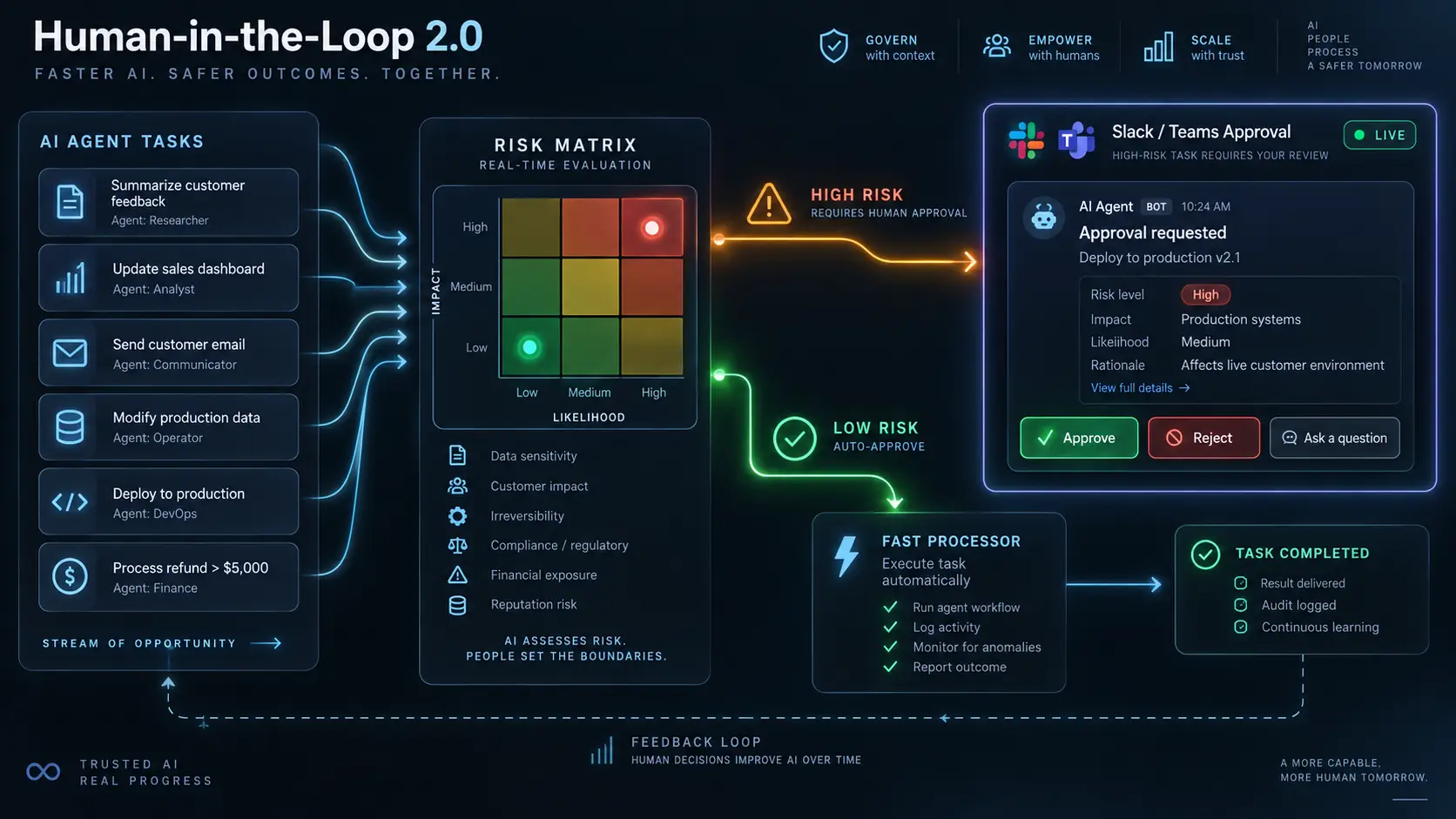
Human-in-the-Loop 2.0: Designing Escalation Triggers That Don't Bottleneck Agents
Requiring human approval for every agent action is not governance — it is a queue. Here is how risk scoring, confidence thresholds and async escalation keep agents fast and safe.

The AI Agent Containment Gap: Why You Can't Shut Down a Rogue Agent
60% of enterprises can't quickly shut down a misbehaving AI agent. Here's the four-primitive containment architecture that closes the gap before an incident.

AI Agent Rollback & Recovery: A Production Playbook for 2026
When an AI agent takes the wrong action in production, can you undo it? A practical rollback and recovery playbook for enterprises running agents at scale.