
Most CIOs think they know how much AI their company uses. They don't. The real number is roughly ten times higher than what shows up in their SaaS management platform, and the gap is widening every quarter.
Welcome to the shadow AI problem, the single most underrated enterprise risk of 2026. Employees at more than 90% of surveyed companies are using personal AI accounts for daily work tasks, while only 40% of organizations provide official LLM tools. Nearly half of all generative AI usage inside enterprises happens through personal accounts that completely bypass IT, legal, and security. Meanwhile, only 37% of organizations have an AI governance policy in place.
This is not a theoretical risk. It is a live data exfiltration channel that your employees are happily feeding with customer lists, source code, pricing models, draft contracts, and board decks, one prompt at a time.
Why Shadow AI Exploded in 2026
Three forces converged this year to make the problem significantly worse.
First, consumer AI tools outpaced enterprise rollouts. While procurement committees debated Microsoft Copilot licensing, ChatGPT and Claude shipped agentic features, memory, browser automation, and deep research that employees immediately adopted on personal accounts.
Second, browser-based AI assistants and Chrome extensions made discovery trivial. A salesperson installing a single extension can grant an AI vendor read access to every tab, including your CRM and internal wiki, without ever triggering a procurement review. Citizen-developer tooling compounds this: employees are not just using AI, they are shipping their own AI workflows without IT involvement.
Third, autonomous agents changed the risk profile entirely. Shadow AI used to be a copy-paste problem. Now it's an identity-and-access problem: unsanctioned agents hold persistent credentials, operate at machine speed, and make decisions without a human in the loop. Gartner forecasts AI governance spending will reach $492 million in 2026 and exceed $1 billion by 2030, largely driven by this shift.
The Real Business Costs
Shadow AI creates four concrete exposures that show up on earnings calls and in regulator letters.
Data leakage. Samsung's 2023 incident, where engineers pasted proprietary code into ChatGPT, was a preview. In 2026, similar leaks are happening weekly at mid-market firms, most of which never get disclosed because there is no log.
Compliance failures. Under the EU AI Act, GDPR, HIPAA, and the new state-level AI laws in Washington, California, and Texas, you are responsible for data your employees send to AI vendors, whether or not you approved the tool. Without an audit trail, you cannot prove retention, residency, or vendor obligations were met.
Duplicate spend. When procurement finally does an AI audit, they typically find 8 to 15 overlapping AI subscriptions charged to corporate cards, plus personal accounts handling enterprise data outside any contract.
Autonomous agent risk. An unsanctioned agent with OAuth access to your Google Workspace or Microsoft 365 tenant can exfiltrate, modify, or delete data at speeds no human could match, and your DLP tools are not tuned for it.
The Governance Playbook
Banning AI doesn't work. Employees who want productivity gains will route around prohibitions, and the 89% reduction in unauthorized use seen when sanctioned alternatives are provided tells you where the leverage actually is. Here is the playbook we use with Cynked clients.
1. Get Visibility Before Writing Policy
You cannot govern what you can't see. Start with a 30-day discovery sprint using a combination of tools:
- Network and DNS logs to identify traffic to known AI endpoints (api.openai.com, api.anthropic.com, generativelanguage.googleapis.com, and 200+ others).
- SaaS governance platforms like Nudge Security, Zylo, or Reco to surface OAuth grants and browser extensions.
- CASB or SSE tools like Netskope, Zscaler, or Island Browser for in-line inspection of prompts and responses.
- Expense report scans for AI-related reimbursements, which often expose personal account usage.
Expect to find 3 to 10 times more AI tools than your CMDB shows.
2. Classify Tools Into Three Tiers
Rather than a binary allow/block list, use a tiered model:
- Tier 1 – Fully approved: Enterprise Copilot, ChatGPT Enterprise, Claude for Work, Gemini for Workspace. Standard data handling rules apply.
- Tier 2 – Limited use: Specialized tools (Cursor, Perplexity Enterprise, Notion AI) approved for specific data classes, no regulated data, no customer PII.
- Tier 3 – Prohibited: Consumer accounts of any AI, unvetted Chrome extensions, tools with unclear training-data policies.
Publish the list. Update it monthly. Make approvals fast or employees will route around you again.
3. Build a 10-Day Approval Pathway
The root cause of shadow AI is slow procurement. If an employee asks for a tool and hears nothing for six weeks, they will use a personal account. Target a 10-business-day turnaround with a lightweight intake form covering data types, vendor SOC 2, training-data stance, and DPA terms.
4. Deploy Sanctioned Alternatives Aggressively
Roll out Tier 1 tools broadly and communicate heavily. The drop in unauthorized usage from providing an approved alternative is the highest-ROI intervention in the entire playbook, an 89% reduction for less than the cost of a single breach investigation.
5. Govern Agents, Not Just Chatbots
For agentic AI, extend your identity governance program. Treat each agent as a non-human identity with a defined scope, rotating credentials, time-bounded access, and an owner of record. Microsoft Entra Agent ID, Okta's Identity Security Posture Management, and AWS IAM Access Analyzer all shipped agent-aware features in Q1 2026, use them.
6. Train For the Prompt, Not the Policy
Most AI training focuses on policy memorization. Employees need prompt-level guidance: what data is safe to paste, what to redact, when to use which tool. A 30-minute scenario-based module beats a 40-page policy document every time.
What to Do in the Next 30 Days
For CTOs and CIOs reading this, here is a concrete starting checklist:
- Pull last quarter's expense reports and grep for AI vendor names.
- Run a tenant-wide OAuth audit in Microsoft 365 and Google Workspace.
- Identify the single most-used unsanctioned tool and deploy the enterprise equivalent.
- Draft a one-page tiered AI tool policy and socialize it with a Loom video, not a 90-slide deck.
- Assign one accountable owner for AI governance, usually a Director of Security or Head of IT, with budget authority.
Shadow AI is not going away. But organizations that move now will convert an uncontrolled risk into a controlled, measurable productivity advantage while their competitors are still arguing about whether to block ChatGPT at the firewall.
Get a Shadow AI Assessment
Cynked helps mid-market and enterprise clients run 30-day shadow AI discovery sprints, design tiered governance policies, and deploy sanctioned AI platforms with measurable adoption. If you suspect your real AI footprint is larger than what your dashboards show, it almost certainly is. Contact Cynked to scope a shadow AI assessment for your organization.
Further reading: Part of shrinking shadow AI is giving your team sanctioned, well-understood ways to build with it. FreeAcademy's guides on how to use AI agents in your daily workflow (2026 guide) and how to build your first AI app in 2026 (no ML degree required) give employees legitimate paths to experimentation inside governed boundaries. For internal hiring and reskilling, how to become a developer and land your first job in 2026: the complete guide is a useful resource to share with teams transitioning into AI-operations roles.
Need a scalable stack for your business?
Cynked designs cloud-first, modular architectures that grow with you.
Related Articles

Your AI Agents Have Logins. Most Companies Aren't Managing Them
AI agents now outnumber human users 45-to-1 in many enterprises, and legacy IAM can't govern them. Here's how to secure non-human identities before they become your biggest breach risk.
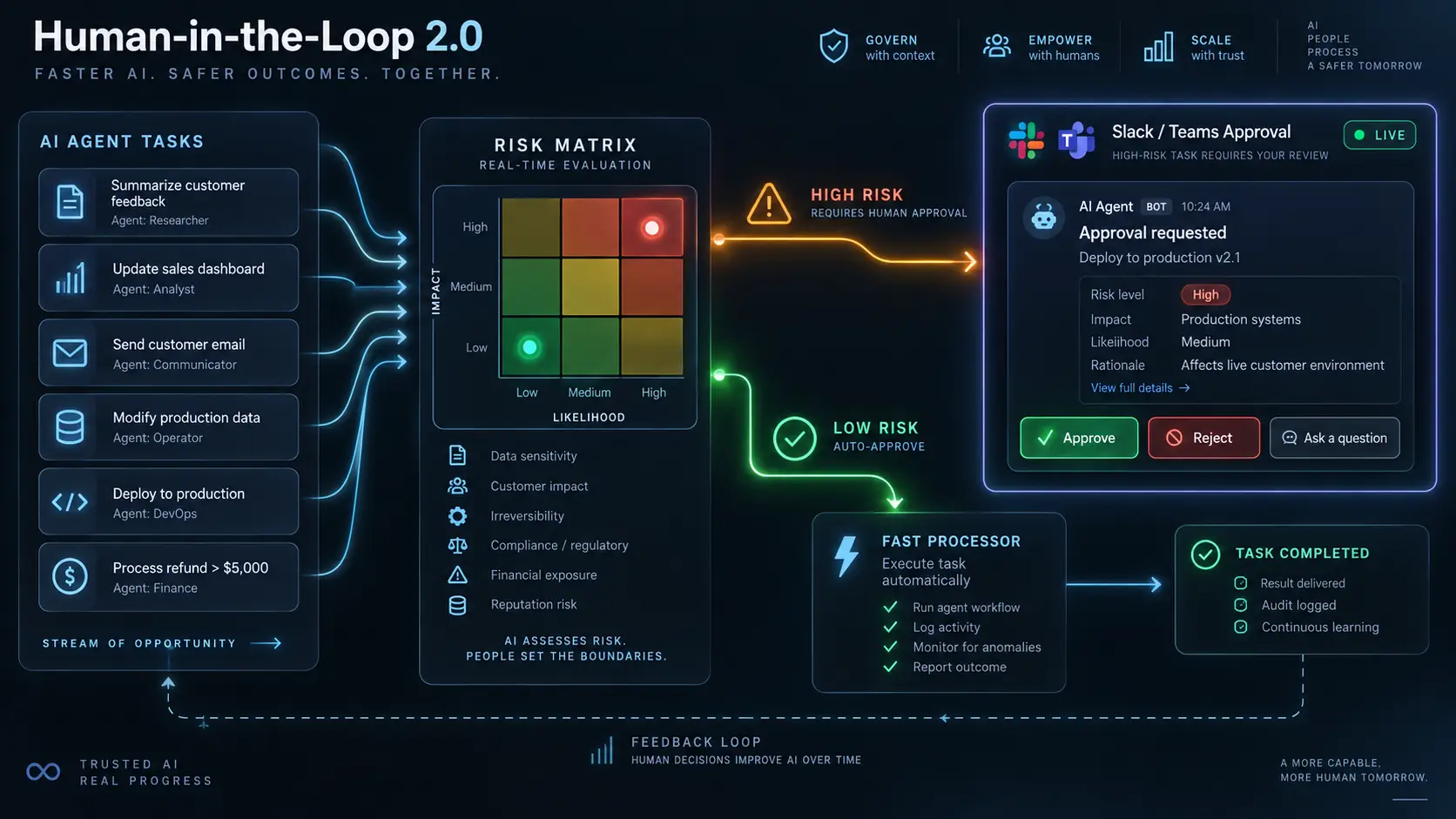
Human-in-the-Loop 2.0: Designing Escalation Triggers That Don't Bottleneck Agents
Requiring human approval for every agent action is not governance — it is a queue. Here is how risk scoring, confidence thresholds and async escalation keep agents fast and safe.

The AI Agent Containment Gap: Why You Can't Shut Down a Rogue Agent
60% of enterprises can't quickly shut down a misbehaving AI agent. Here's the four-primitive containment architecture that closes the gap before an incident.