

Every CIO I've spoken with in the last quarter has told me some version of the same story: their AI agent pilot worked beautifully in the demo, then stalled the moment it had to touch a production system.
The numbers back this up. According to Writer's 2026 enterprise AI report, 79% of organizations now face significant challenges adopting AI — a double-digit increase from last year. Google Cloud's 2026 agent trends research found that 65% of enterprise leaders cite agentic system complexity as their top barrier, and Gartner is now predicting that over 40% of agentic AI projects will fail by 2027 if governance and integration controls aren't established.
Notice what's missing from that list: model intelligence. The models are good enough. The bottleneck has moved.
The integration problem, in plain English
A modern enterprise AI agent needs to do three things reliably:
- Read from systems of record (CRM, ERP, data warehouse, ticketing, knowledge bases)
- Act on those systems (create tickets, update records, post transactions, trigger workflows)
- Prove what it did, to whom, and under whose authority
Most reference architectures handle (1) well — RAG pipelines are a solved problem. They handle (2) badly — bespoke tool definitions, hard-coded credentials, no unified permission model. And they barely handle (3) at all — which is exactly why security teams block production rollouts.
Arcade's State of AI Agents report put it bluntly: "The hardest part of deploying agentic workflows is not intelligence, but secure and reliable access to production systems."
What good integration architecture looks like in 2026
After working with clients across financial services, healthcare, and retail, a durable pattern has emerged. Five layers, each with a clear owner.
1. A standardized protocol layer
Stop writing custom tool definitions for every agent project. Adopt Model Context Protocol (MCP) or an equivalent standard as your connector interface. Anthropic, OpenAI, Google, and Microsoft now all support MCP or compatible patterns, which means a connector you build once works across the frameworks your teams will actually use.
Practical takeaway: maintain an internal MCP server registry the same way you maintain a REST API catalog.
2. Identity-aware access
An agent should never have standing credentials more powerful than the human on whose behalf it's acting. Use OAuth 2.0 token exchange or SPIFFE identities so the agent inherits the requesting user's scope. When an agent calls your CRM, the row-level security in the CRM should still apply — no agent backdoors.
3. Policy enforcement at the tool boundary
Put a policy engine (Open Policy Agent, Cedar, or a cloud-native equivalent) between the agent and every sensitive tool. Policies should answer: Can this agent, acting for this user, perform this action, on this data, right now? Policies live in source control and are reviewed by security, not prompt-engineered by the AI team.
4. Observability built for agents, not microservices
Standard APM tools miss the plot. You need trace capture at the reasoning step level: what tool was chosen, why, what input, what output, how many tokens, and what downstream actions fired. LangSmith, Arize, and Datadog's LLM observability all handle this now. Budget for it on day one.
5. Human-in-the-loop for irreversible actions
Define a bright line: any action that moves money, modifies production data, sends an external communication, or touches PII requires explicit human approval — even if the agent is 99% confident. This single rule has eliminated more board-level AI risk than any guardrail prompt ever will.
A concrete example: claims triage at a mid-size insurer
One of our clients wanted an AI agent to triage incoming insurance claims. The pilot, built by a vendor, worked in 48 hours. Production deployment took nine months — not because of the model, but because:
- The agent needed access to three policy admin systems, each with different auth
- Regulators required a full audit trail of every agent decision
- Adjuster unions wanted guaranteed human review of any denial
- Finance capped the agent's monthly inference spend
Once we rebuilt around the five-layer pattern — MCP connectors, OAuth token exchange, OPA policies, LangSmith tracing, and approval workflows for denials — the agent went live. Result: claims triage time dropped from 4.2 days to 6 hours, with a 0% regulatory finding rate over the first two quarters.
The model was never the interesting part. The integration architecture was.
What to do this quarter
If you're evaluating or scaling AI agents, here's a 90-day action list:
- Audit your current agent tool definitions. How many are bespoke? Consolidate onto MCP or a single internal standard.
- Map agent identities to human identities. No more service accounts with god-mode permissions.
- Pick one irreversible action type (wire transfers, customer emails, schema changes) and require human approval for it. Expand from there.
- Set a monthly agent cost ceiling per use case and wire it to automatic shutoff.
- Instrument reasoning-step tracing before your next agent goes to production. Retrofitting this later costs 5–10× more.
The takeaway
The AI industry spent 2024 and 2025 obsessing over model capability. The winners of 2026 and 2027 will be the companies that obsess over secure, observable, governable integration. That's where production ROI lives. That's where the Gartner failure rate gets decided.
If you're stuck between an impressive demo and a stalled rollout, the fix is almost certainly not a better model. It's a better integration layer.
Cynked helps mid-market and enterprise teams architect production-grade AI agents — from MCP connector design to policy enforcement and audit-ready observability. If your agents keep failing the security review, get in touch and we'll show you the pattern that gets them shipped.
Need a scalable stack for your business?
Cynked designs cloud-first, modular architectures that grow with you.
Related Articles
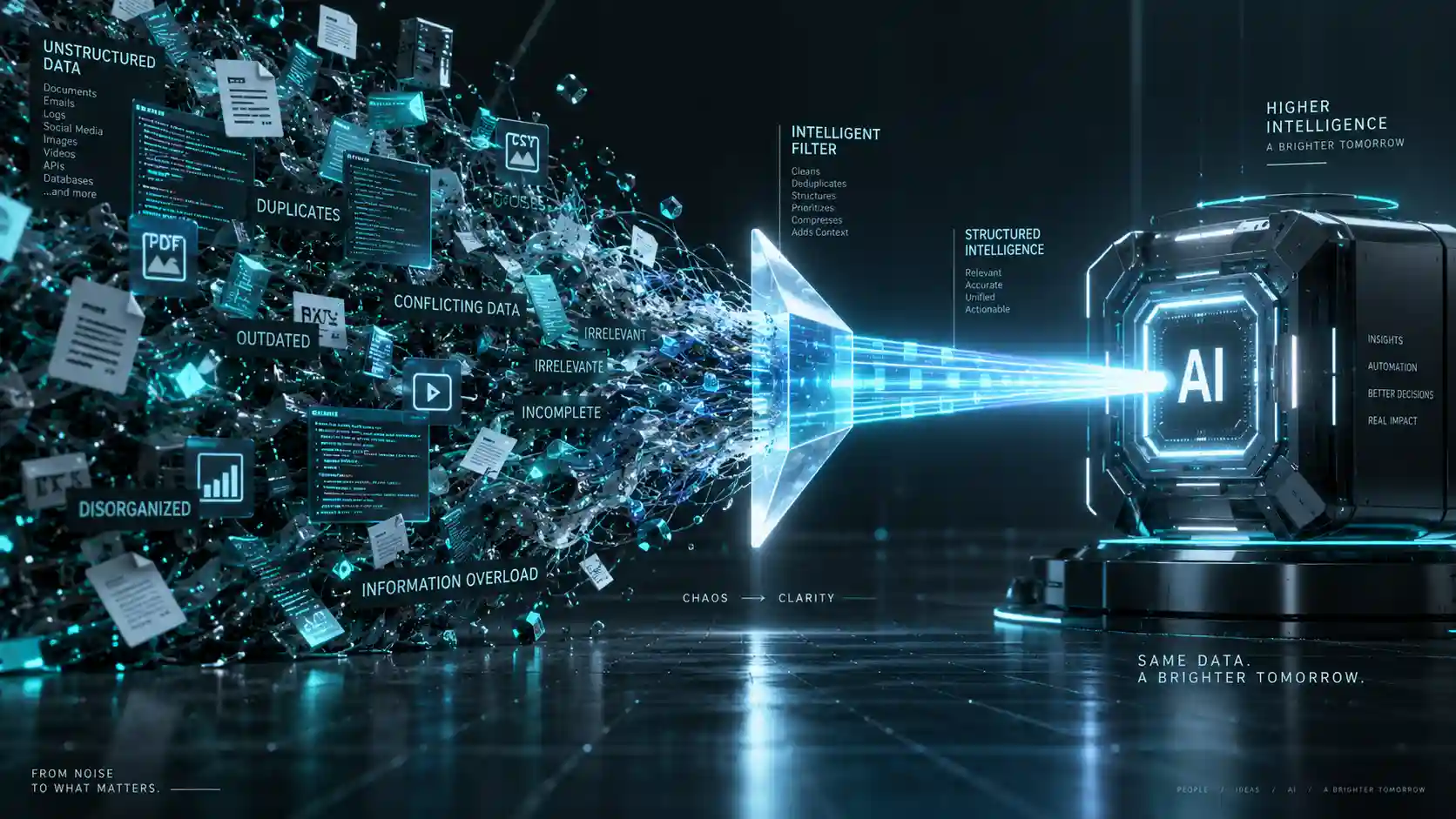
Context Window Bloat: Why Feeding More Data to LLMs Is Ruining Your AI Agent's ROI
Stuffing huge payloads into LLM context windows makes agents slower, more expensive, and less accurate. Here is what context bloat costs and how to build a lean context architecture.

Embedded AI vs Bolt-On Tools: The 6x Failure Gap
AI tools bolted onto existing workflows fail 6x more often than embedded ones. Here's how to embed AI inside your business processes for real ROI.

Vertical AI Agents Deliver 500% ROI: A Buyer's Guide for 2026
Vertical AI agents return ~500% ROI vs ~171% for horizontal tools. Learn when to pick specialized agents, how to evaluate vendors, and avoid costly mistakes.