

The Clock Is Ticking
On August 2, 2026, the EU AI Act's high-risk provisions take full effect. If your business deploys AI systems that influence hiring, credit decisions, customer screening, or any other consequential outcome for people in the European Union, you have less than four months to get compliant.
This is not a distant regulatory threat. It is the most significant piece of AI legislation in the world, and it applies to any company — regardless of headquarters — whose AI outputs touch EU residents.
According to a 2026 Deloitte report, 88% of enterprises now use AI automation, but fewer than a third have the governance structures needed to meet regulatory requirements. The gap between deployment and compliance is where the risk lives.
What the EU AI Act Actually Requires
The Act classifies AI systems into four risk tiers: unacceptable (banned), high-risk (heavily regulated), limited risk (transparency obligations), and minimal risk (no requirements). Most business AI falls into the high-risk or limited-risk categories.
For high-risk systems, the requirements are substantial:
- Risk management: Implement and maintain a documented risk management system throughout the AI system's lifecycle
- Data governance: Ensure training data meets quality criteria, is relevant, and is sufficiently representative
- Technical documentation: Maintain detailed records of system design, development process, and capabilities
- Record-keeping: Enable automatic logging of events while the system operates
- Transparency: Provide clear instructions for downstream deployers, including system limitations
- Human oversight: Design systems so humans can effectively oversee their operation
- Accuracy and robustness: Meet appropriate levels of accuracy, robustness, and cybersecurity
For limited-risk systems (chatbots, content generators, deepfakes), you must disclose to users that they are interacting with AI.
Why This Matters Beyond Europe
The EU AI Act is creating a regulatory ripple effect. In the United States alone, Colorado's SB 205 took effect on February 1, 2026, requiring impact assessments for high-risk AI deployments. Texas passed its Responsible Artificial Intelligence Governance Act, effective January 1, 2026. California now mandates training data disclosure for generative AI developers under AB 2013.
Companies that build compliance infrastructure for the EU AI Act will find themselves well-prepared for this expanding patchwork of US state regulations. Those that do not will face mounting costs as each new jurisdiction adds its own requirements.
A Practical 4-Month Action Plan
With the August deadline approaching, here is a prioritized roadmap.
Month 1: Inventory and Classify (April)
Map every AI system in your organization. This includes obvious deployments like customer-facing chatbots and recommendation engines, but also less visible uses — resume screening tools, fraud detection models, automated pricing algorithms, and any third-party software with embedded AI features.
For each system, determine:
- What decisions does it make or influence?
- Who is affected by those decisions?
- Does it fall into a high-risk category under the Act?
Most organizations discover 30–50% more AI touchpoints than they initially estimate. Marketing teams using AI for ad targeting, HR departments using AI-assisted screening, and finance teams using automated credit models all count.
Month 2: Gap Analysis and Documentation (May)
Compare your current practices against the Act's requirements. For each high-risk system, assess:
- Do you have documented risk management procedures? Not just a risk register, but an active management process.
- Can you demonstrate data quality and governance for training datasets?
- Is there meaningful human oversight, or does the system operate autonomously?
- Are your technical documentation and logging capabilities sufficient?
The gap analysis will reveal where you need to invest. According to IBM's analysis of AI ROI, organizations that invest in governance infrastructure early see 2.5x better returns on their AI investments. Compliance is not just a cost — it is a quality multiplier.
Month 3: Implement and Test (June)
Close the gaps identified in your analysis. Priority actions typically include:
- Establish a human oversight protocol for each high-risk system. Define who reviews AI outputs, how frequently, and what triggers manual intervention.
- Build or upgrade logging infrastructure to capture the automatic event records the Act requires.
- Create transparency documentation — clear, plain-language descriptions of what your AI systems do, their limitations, and how affected individuals can seek recourse.
- Conduct bias and accuracy testing across demographic groups and edge cases.
Do not try to build everything from scratch. Tools like IBM's AI FactSheets, Microsoft's Responsible AI Toolkit, and open-source frameworks like MLflow can accelerate documentation and monitoring.
Month 4: Validate and Prepare for Ongoing Compliance (July)
Run a mock audit. Have your legal and technical teams — or an external partner — review your compliance posture as if the regulator were at the door. Test your documentation, verify your logging works, and confirm your human oversight protocols function under realistic conditions.
Establish a continuous compliance process. The EU AI Act is not a one-time checkbox. You need:
- Regular risk reassessments as systems are updated
- Ongoing monitoring of AI outputs for drift and bias
- A clear process for reporting serious incidents to authorities within the required timeframes
- Updated documentation when models are retrained or system architectures change
The Governance Advantage
Here is what the compliance conversation often misses: organizations with strong AI governance do not just avoid fines — they perform better.
Writer's 2026 enterprise survey found that enterprises where senior leadership actively shapes AI governance achieve significantly greater business value than those delegating oversight to technical teams alone. When 97% of executives report deploying AI agents but only 5–29% see meaningful ROI, governance is one of the clearest differentiators between organizations that extract value and those that just spend money.
Strong governance forces clarity about what AI systems are supposed to achieve, how their performance is measured, and who is accountable for outcomes. That clarity drives better decisions about where to invest, what to scale, and what to shut down. The same data-governance and reporting muscle you build for the Act pays off in adjacent regulated domains — see how AI is turning ESG from a compliance burden into a competitive advantage for a parallel playbook.
What Happens If You Miss the Deadline
The penalties under the EU AI Act are designed to be material. Fines for high-risk violations can reach 15 million euros or 3% of global annual turnover, whichever is higher. For prohibited AI practices, fines scale to 35 million euros or 7% of turnover.
Beyond fines, non-compliance creates operational risk. Business partners and customers in the EU will increasingly require compliance evidence as a condition of doing business, much as GDPR compliance became a procurement requirement.
Start Now, Not Later
Four months is tight but workable if you start immediately. The organizations that will struggle are those waiting for final guidance, hoping for enforcement delays, or assuming the rules will not apply to them.
The EU AI Act is not an obstacle to AI adoption. It is a framework for doing AI well — with accountability, transparency, and the kind of rigor that separates valuable AI deployments from expensive experiments.
Need help preparing for the EU AI Act deadline? Contact Cynked for a compliance readiness assessment. We help businesses map their AI systems, identify gaps, and build governance frameworks that satisfy regulators and drive real business value.
Further reading: Part of compliance is knowing exactly which plan and provider your teams are on. FreeAcademy's plan breakdowns — Claude Free Plan Limits 2026: what you get, what you don't, Claude Free vs Pro vs Max (April 2026): which plan is actually worth it, Is Claude Max worth it in 2026? Real review of the $100 and $200 plans, Gemini Free vs Advanced vs Business: is Gemini Advanced worth it in 2026, and ChatGPT Free vs Plus vs Business vs Pro: complete comparison 2026 — help you map each AI tool your employees use to its data-handling and retention terms. For teams building in-house compliance tooling, FreeAcademy covers how to build your first AI app in 2026 (no ML degree required), how to use AI agents in your daily workflow (2026 guide), and how to become a developer and land your first job in 2026: the complete guide. Once your governance is in place and you want your compliance content to be cited by AI systems, see their micro-course on making your content citable by AI and the Google AdSense Mastery course if monetisation is in scope.
Need a scalable stack for your business?
Cynked designs cloud-first, modular architectures that grow with you.
Related Articles
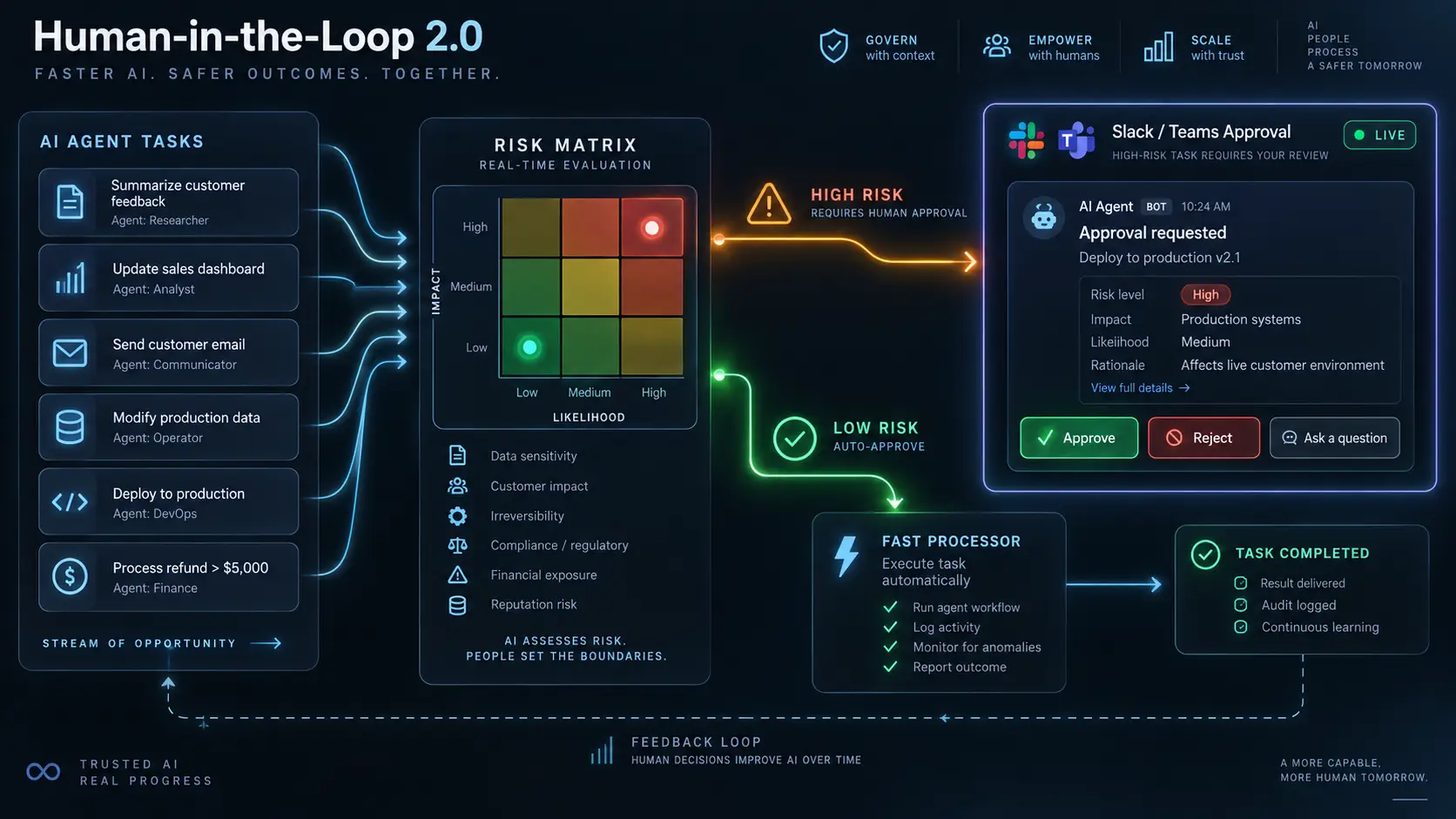
Human-in-the-Loop 2.0: Designing Escalation Triggers That Don't Bottleneck Agents
Requiring human approval for every agent action is not governance — it is a queue. Here is how risk scoring, confidence thresholds and async escalation keep agents fast and safe.

AI Agent Rollback & Recovery: A Production Playbook for 2026
When an AI agent takes the wrong action in production, can you undo it? A practical rollback and recovery playbook for enterprises running agents at scale.

AI Agent Observability: Monitoring Autonomous Systems in Production
AI agents run autonomously in production—but most enterprises can't see what they're doing. Here's how to build observability before regulators demand it.