
The Agent Advantage in E-Commerce
E-commerce operates at a pace and scale that human teams alone cannot sustain. Every order generates a cascade of downstream processes — inventory updates, shipping notifications, customer communications, return handling, review management. When your store processes hundreds or thousands of orders per day, the operational overhead becomes the bottleneck, not the product itself.
AI agents are purpose-built for this kind of work. Unlike traditional automation that follows rigid if-then rules, agents interpret context, make decisions, and handle exceptions. They do not just execute tasks — they manage workflows end-to-end, escalating to humans only when a situation genuinely requires human judgment.
In 2026, the e-commerce businesses pulling ahead are the ones deploying agents strategically across their operations. Not as experiments, but as core operational infrastructure. Adoption is now mainstream, and the barrier to entry has dropped sharply, meaning mid-market teams can now realistically design and deploy their own. Here are the seven agents delivering the highest return on investment.
1. Customer Support Agent
Customer support is the most obvious and most impactful place to deploy an AI agent. The economics are straightforward: support teams are expensive, ticket volumes are unpredictable, and a large percentage of inquiries follow repeatable patterns.
A well-deployed customer support agent does not simply answer FAQs. It accesses order data, tracks shipments, processes simple requests like address changes or cancellations, and resolves common issues — password resets, order status inquiries, return initiations — without any human involvement. When a query falls outside its scope, it gathers context and routes the ticket to the right human agent with a summary of what it has already tried.
The numbers speak for themselves. Businesses deploying support agents typically see 40 to 60 percent of tickets resolved without human intervention. Response times drop from hours to seconds. Customer satisfaction scores often improve because customers get immediate answers instead of waiting in a queue. For phone-based support — where call volumes still dominate operational cost — our 2026 business guide to AI voice agents for customer service covers vendors, ROI benchmarks, and a 90-day rollout plan.
Where It Works Best
- High-volume stores with predictable inquiry patterns
- Businesses with clear policies that can be encoded into agent logic
- Stores operating across multiple time zones where 24/7 human coverage is cost-prohibitive
Implementation Tip
Start with a narrow scope — order tracking and return initiation are ideal first use cases. Expand the agent's capabilities only after it demonstrates reliable performance in the initial scope.
2. Product Description Agent
Product descriptions are a quiet bottleneck. Most e-commerce businesses have hundreds or thousands of SKUs, each needing a unique, compelling, SEO-optimised description. Writing these manually is slow and expensive. Writing them badly costs you search traffic and conversions.
A product description agent takes structured product data — specifications, features, category, target audience — and generates descriptions that are accurate, on-brand, and optimised for search. It can produce descriptions in multiple languages, adjust tone and length for different channels (your website versus a marketplace listing versus a social media ad), and update descriptions in bulk when your messaging or SEO strategy changes.
The time savings are substantial. A task that takes a copywriter 15 to 30 minutes per product takes an agent seconds. For a catalogue of 5,000 products, the difference between weeks of human effort and hours of agent work is transformative.
Where It Works Best
- Stores with large catalogues and frequent product additions
- Businesses selling across multiple channels with different description requirements
- Companies entering new markets and needing multilingual descriptions
Implementation Tip
Provide the agent with your brand voice guidelines and 20 to 30 examples of descriptions you consider excellent. Quality input produces quality output. Always have a human review a sample of generated descriptions before publishing at scale.
3. Personalised Recommendation Agent
Recommendation engines are not new, but AI agents take them to a different level. Traditional recommendation systems use collaborative filtering — "customers who bought X also bought Y." An AI recommendation agent understands context, timing, and intent.
This agent analyses a customer's browsing behaviour, purchase history, cart contents, and even the time of day to generate recommendations that feel genuinely relevant. It can distinguish between someone browsing casually and someone who is ready to buy. It adjusts recommendations in real time as the customer navigates your store.
The revenue impact is significant. Personalised recommendations typically increase average order value by 10 to 30 percent. More importantly, they improve the customer experience — people find what they want faster, which reduces bounce rates and increases return visits.
Where It Works Best
- Stores with diverse product catalogues where discovery is a challenge
- Businesses with enough traffic and transaction data to train meaningful models
- Subscription-based e-commerce where predicting next purchases drives retention
Implementation Tip
Measure recommendation performance by revenue per session, not just click-through rate. A recommendation that gets clicked but does not convert is not delivering value.
4. Inventory Forecasting Agent
Inventory management is a balancing act. Too much stock ties up capital and risks obsolescence. Too little stock means lost sales, backorders, and frustrated customers. Getting it right requires forecasting demand accurately — and demand is influenced by dozens of variables that change constantly.
An inventory forecasting agent analyses historical sales data, seasonal patterns, marketing calendars, external factors like economic indicators or weather, and even social media trends to predict demand at the SKU level. It generates purchase recommendations, flags potential stockouts before they happen, and adjusts forecasts as new data comes in.
The financial impact is twofold. You reduce carrying costs by not overstocking, and you reduce lost revenue by not understocking. For most e-commerce businesses, improving forecast accuracy by even 10 to 15 percent translates directly to six-figure annual savings.
Where It Works Best
- Businesses with seasonal demand fluctuations
- Stores managing hundreds of SKUs with varying lead times
- Companies with perishable or trend-sensitive inventory
Implementation Tip
Feed the agent as much historical data as you have — at least two years if possible. Include marketing campaign calendars and promotion schedules, as these have an outsized effect on demand spikes that pure historical data will miss.
5. Returns Processing Agent
Returns are expensive. The average return costs an e-commerce business between 15 and 30 dollars to process when you account for shipping, inspection, restocking, and customer communication. At scale, returns processing can consume an entire team's capacity.
A returns processing agent handles the workflow from initiation to resolution. It reviews the return request against your policy, determines whether the item is eligible, generates a return label, provides the customer with instructions, tracks the returned item, triggers the refund or exchange upon receipt, and updates inventory. For straightforward returns, no human touches the process.
The efficiency gains are dramatic. Processing time drops from 10 to 15 minutes per return to near-zero for standard cases. The agent also identifies patterns — if a particular product has a high return rate, it flags the issue for your product team to investigate.
Where It Works Best
- High-volume stores with return rates above industry average
- Businesses with clear, well-documented return policies
- Stores where returns processing is a significant operational cost
Implementation Tip
Define clear escalation rules. The agent should handle standard cases autonomously but escalate exceptions — damaged items, suspected fraud, high-value returns — to a human reviewer immediately.
6. Dynamic Pricing Agent
Pricing in e-commerce is a real-time game. Your competitors adjust their prices constantly, demand shifts by the hour, and your margins vary by product and channel. Setting prices manually or through static rules means you are always reacting instead of optimising.
A dynamic pricing agent monitors competitor prices, demand signals, inventory levels, and margin targets to recommend or automatically set optimal prices. It can run different pricing strategies for different segments — new customers might see introductory pricing while loyal customers see bundle discounts. It adjusts in real time, responding to market changes faster than any human team could.
The revenue and margin improvement is meaningful. Businesses using AI-driven pricing typically see margin improvements of 5 to 15 percent without sacrificing volume. The agent finds the sweet spots that manual pricing consistently misses.
Where It Works Best
- Competitive markets where pricing changes frequently
- Stores with large catalogues where manual price management is impractical
- Businesses selling commodity or near-commodity products where price is a primary differentiator
Implementation Tip
Set clear guardrails. Define minimum and maximum prices, margin floors, and rules about how frequently prices can change. Unconstrained dynamic pricing can create customer trust issues if prices fluctuate too visibly.
7. Review and Sentiment Analysis Agent
Customer reviews are a goldmine of product and operational intelligence. But reading and analysing hundreds or thousands of reviews manually is not feasible. Most businesses only look at reviews when there is a visible problem — a spike in negative feedback or a viral complaint.
A review and sentiment analysis agent continuously monitors reviews across all your channels — your website, Amazon, social media, Google — and extracts actionable insights. It categorises feedback by theme (product quality, shipping speed, packaging, customer service), tracks sentiment trends over time, flags emerging issues before they escalate, and generates summary reports for product, operations, and marketing teams.
The strategic value goes beyond damage control. The agent can identify features customers love (so you can emphasise them in marketing), common complaints about competitors (so you can differentiate), and unmet needs that suggest product development opportunities.
Where It Works Best
- Businesses selling across multiple channels with dispersed review data
- Stores with high review volumes where manual monitoring is impractical
- Companies that want to be proactive rather than reactive about customer feedback
Implementation Tip
Connect the agent's output to your product development and marketing workflows. Insights that sit in a dashboard but never reach decision-makers do not create value.
Where to Start
Deploying seven agents at once is neither practical nor advisable. The businesses that get the best results start with one agent, prove its value, learn from the deployment, and expand methodically.
Choose your first agent based on three criteria:
- Highest volume — which process handles the most transactions or interactions?
- Clearest rules — which process has the most well-defined, documented procedures?
- Easiest measurement — where can you most clearly measure before-and-after performance?
For most e-commerce businesses, customer support or returns processing meets all three criteria. Start there.
Once your first agent is running reliably, use what you learned — about integration challenges, team adoption, and measurement — to plan your second deployment. Each agent you add creates compounding efficiency gains, because agents can share data and insights across workflows.
The Competitive Reality
AI agents in e-commerce are no longer a competitive advantage — they are becoming table stakes. Major platforms and infrastructure providers are already going all-in, ushering in an era of local-first AI agents that can run closer to your systems and data. Standards are catching up too, with MCP becoming the common layer for agent-to-tool integrations, making them dramatically cheaper than the custom middleware most stores currently rely on. The businesses that deploy them first capture efficiency gains that fund further investment. The businesses that wait find themselves competing against leaner, faster, more responsive operations.
The question is not whether to deploy AI agents. It is which ones to deploy first, and how to do it well.
If you are ready to identify which agents will deliver the highest ROI for your e-commerce operation, book a discovery call with Cynked. We help mid-market e-commerce businesses design, deploy, and optimise AI agents that deliver measurable results — without the vendor hype or the science project risk.
Want to learn more? FreeAcademy's practical guide on how to use AI agents in your daily workflow covers hands-on strategies for integrating agents into your operations. The deep dive on agentic RAG: how AI agents supercharge retrieval in 2026 explains the architecture powering modern product-catalog and customer-support agents, and their guide on how to evaluate AI agents: metrics, benchmarks and testing in 2026 is the right companion when you are picking the first agent to ship.
For technical teams deciding which coding agent to build on, FreeAcademy's comparison of Claude Code vs OpenClaw: which AI coding agent should you use in 2026 is a useful primer. When picking the LLM to power those agents, see their head-to-heads on Gemini vs ChatGPT vs Claude — which AI should you use in 2026, which ChatGPT model should you use in 2026 (GPT-5, o3, o4-mini explained), Gemini Free vs Advanced vs Business — is Gemini Advanced worth it in 2026, and ChatGPT Free vs Plus vs Business vs Pro: complete comparison 2026. For product research and merchandising workflows, Perplexity vs ChatGPT vs Google — which AI research tool should you use in 2026 is worth a look. And for the engineers wiring agents into your stack, FreeAcademy's reference on 5 regex patterns every developer should know is a handy cheat sheet for the data-cleanup work these deployments usually require, and LangChain functions, tools, and agents: practical guide 2026 covers the framework most production agent stacks are built around.
Need a scalable stack for your business?
Cynked designs cloud-first, modular architectures that grow with you.
Related Articles

How to Use AI Agents to Run Multiple Websites Without a Team
A real-world case study of running 6 websites with AI agents handling content publishing, SEO monitoring, email automation, and strategic planning. No employees, no freelancers. Here is how the system works.

AI Agents in the Enterprise: Where to Start and What to Avoid
AI agents can automate complex multi-step workflows — but deployed in the wrong place, they create new problems. Here is a practical framework for enterprise leaders deciding where to start.
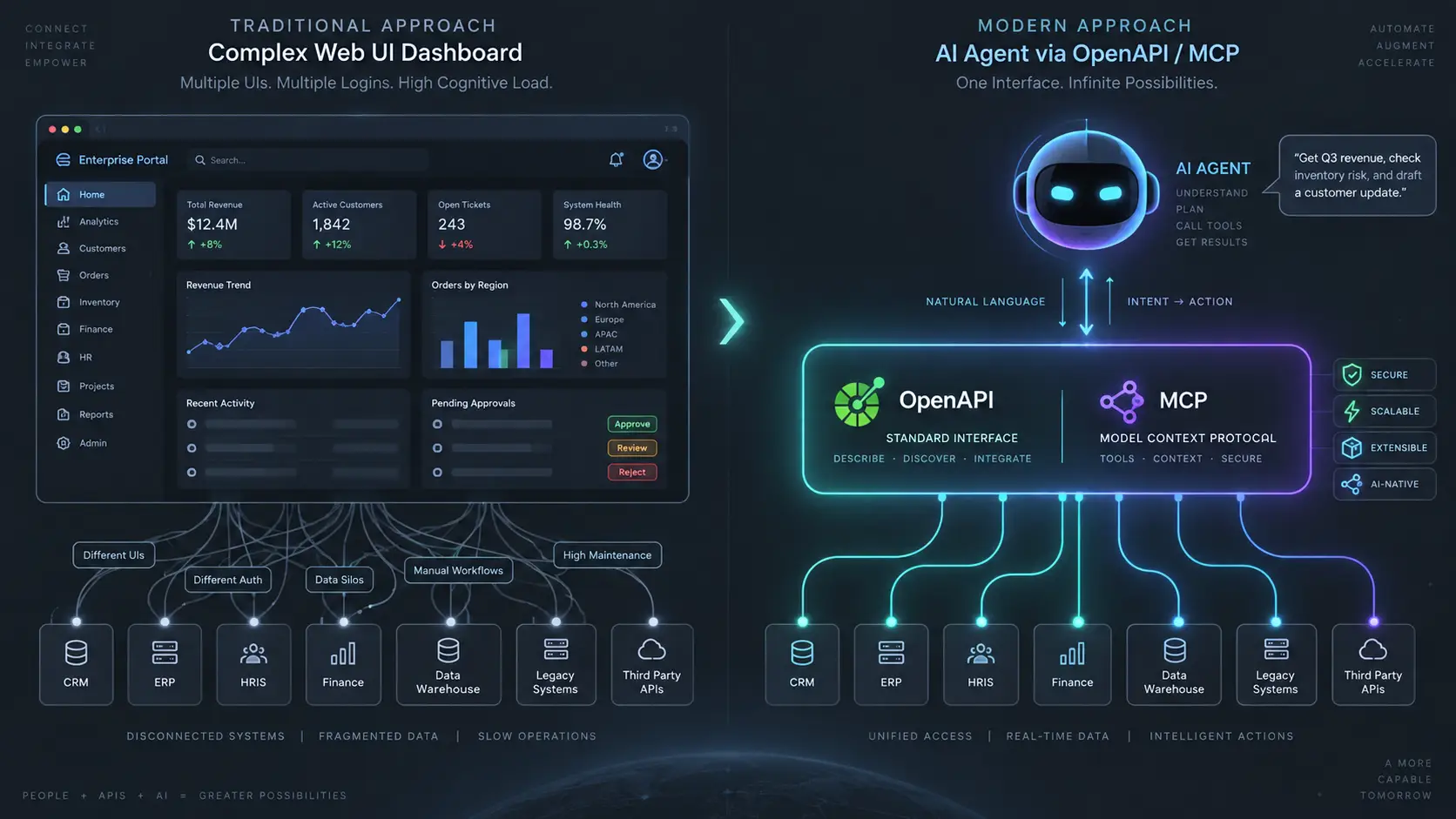
The Agent-Native API: Why OpenAPI & MCP Specs Are the New Enterprise UI
AI agents don't click through your web app — they call your endpoints. Here is why traditional REST APIs fail agents, and the four principles of an agent-native API layer.