

The Shift From Chatbots to Autonomous Agents
For the past three years, most businesses have interacted with AI through a single interface: the chat window. You type a prompt, you get a response, you copy-paste it somewhere useful. That model served its purpose. But in 2026, it is rapidly becoming obsolete.
The new paradigm is agentic AI — autonomous systems that do not just answer questions but actually do the work. They read your emails, update your CRM, reroute shipments, resolve support tickets, and trigger follow-up actions across multiple tools. All without waiting for a human to type the next instruction.
This is not a research preview or a startup demo. Gartner now predicts that 40% of enterprise applications will incorporate task-specific AI agents by the end of 2026, up from under 5% in 2025. That is an eightfold increase in a single year. The shift is happening now, and businesses that understand it early will have a significant operational advantage.
What Makes an AI Agent Different
Before diving into use cases, it is worth understanding what separates an AI agent from the AI tools most businesses already use. If you are new to the concept, our AI agents explainer for business owners covers the fundamentals.
A traditional AI tool responds to a single input with a single output. You ask it to summarize a document, it summarizes the document. Done.
An AI agent operates in a loop. It receives an objective, breaks it into subtasks, executes those subtasks across multiple systems, evaluates the results, and adjusts its approach if something does not work. It has access to tools — APIs, databases, file systems, communication platforms — and it decides which tools to use and when.
Three capabilities define modern AI agents:
- Autonomy: They operate independently once given a goal, without requiring step-by-step human instruction.
- Tool use: They can interact with external systems — pulling data from a warehouse, sending an email, updating a record, triggering a deployment.
- Reasoning and planning: They can decompose complex objectives into ordered steps and adapt when conditions change.
This combination is what makes agentic AI transformative. It is not just smarter software — it is software that can operate other software.
Five Use Cases Delivering ROI Today
Agentic AI is not theoretical. Here are five areas where businesses are deploying agents in production right now and seeing measurable results.
1. Autonomous Customer Support
This is the most mature use case. AI agents now handle 60–80% of Tier 1 support tickets end-to-end at companies using platforms like Intercom, Zendesk, and Salesforce Service Cloud with agentic capabilities.
The difference from older chatbots is significant. Where a chatbot would match keywords to a knowledge base article, a support agent can:
- Look up the customer's order history, subscription status, and past interactions
- Determine the root cause of the issue by cross-referencing system data
- Take corrective action (issue a refund, update a shipping address, reset a password)
- Escalate to a human only when the situation genuinely requires it
One mid-size e-commerce company we spoke with reduced average resolution time from 4.2 hours to 11 minutes after deploying an agentic support system — while maintaining a 94% customer satisfaction score. For a deeper look at agent use cases specific to online retail, see our guide to AI agents for e-commerce businesses.
2. AI-Driven Supply Chain Optimization
Supply chains generate enormous volumes of data and require rapid, interconnected decisions. This makes them ideal for agentic AI.
Modern supply chain agents monitor real-time data streams — inventory levels, shipping delays, weather forecasts, demand signals — and make autonomous adjustments:
- Reorder triggers: Automatically placing purchase orders when inventory hits dynamic thresholds (not just static reorder points, but thresholds adjusted based on demand forecasts and lead time variability).
- Route optimization: Rerouting shipments in real time based on port congestion, carrier performance, and cost trade-offs.
- Supplier negotiation: Some advanced implementations use agents to evaluate and respond to supplier quotes based on predefined parameters and historical pricing data.
Deloitte reports that companies using AI-driven supply chain optimization are seeing 15–25% reductions in logistics costs and 20–35% improvements in forecast accuracy compared to traditional planning systems.
3. Workflow Orchestration Across SaaS Tools
Most businesses run on a patchwork of 50–200 SaaS applications. The glue holding them together is usually a combination of Zapier automations, manual data entry, and tribal knowledge. AI agents are replacing that entire layer.
Workflow orchestration agents sit on top of your tool stack and coordinate multi-step processes:
- A new deal closes in your CRM → the agent creates the project in your PM tool, generates the onboarding checklist, schedules the kickoff meeting, provisions the client's accounts, and notifies the delivery team.
- A candidate accepts an offer → the agent triggers background checks, generates the offer letter, creates accounts in HR and payroll systems, and assigns the onboarding buddy.
The key advantage here is adaptability. Unlike rigid workflow automations that break when you change a field name or add a step, agentic orchestrators can interpret intent and adjust to variations. If the PM tool's API changes, the agent can often figure out the new endpoint. If a step fails, it can retry, find an alternative, or flag a human.
4. Financial Operations and Reconciliation
Finance teams spend a staggering amount of time on tasks that are repetitive yet require judgment — invoice matching, expense categorization, variance analysis, audit preparation. AI agents are a natural fit.
In production deployments, finance agents are:
- Matching invoices to purchase orders and receipts across systems, flagging discrepancies for review rather than requiring manual three-way matching
- Categorizing expenses against GL codes with 95%+ accuracy, learning from corrections over time
- Generating month-end reconciliation reports by pulling data from multiple sources and highlighting anomalies
- Preparing audit documentation packages by compiling evidence across systems
McKinsey estimates that 60–70% of finance and accounting tasks have a high potential for automation with current AI technology. Agents are the mechanism that makes this practical at scale.
5. Sales Development and Lead Qualification
Sales development is being transformed by agents that go far beyond auto-generated outreach sequences. Modern sales agents can:
- Research a prospect by pulling data from LinkedIn, company websites, press releases, and your CRM history
- Score and prioritize leads based on behavioral signals and firmographic fit
- Craft personalized outreach that references specific, relevant details about the prospect's business
- Handle initial discovery conversations, qualifying leads against your ICP criteria before routing to a human rep
Early adopters report 2–3x increases in qualified pipeline from sales agents, primarily because the agents can work every lead in the database simultaneously — something no human team can do.
For industry-specific applications, see how agents are transforming healthcare operations with use cases from patient intake to compliance monitoring.
Where to Start: A Practical Framework
The pattern we see repeatedly with our clients is this: businesses get excited about the most complex, high-impact use case and try to start there. That is almost always a mistake.
Here is the framework we recommend:
Step 1: Identify High-Volume, Low-Risk Processes
Look for tasks that are:
- Performed hundreds or thousands of times per month
- Well-documented with clear rules (even if those rules have exceptions)
- Low-stakes when errors occur (easy to catch and correct)
- Currently bottlenecked by human availability
Customer support triage, data entry, and appointment scheduling are classic starting points.
Step 2: Define Clear Success Metrics
Before deploying an agent, establish your baseline and your targets:
- What is the current cost per transaction?
- What is the current error rate?
- What is the current processing time?
- What does "good enough" look like for the agent?
Without these baselines, you will have no way to evaluate whether the agent is actually improving operations or just creating a different set of problems.
Step 3: Start With Human-in-the-Loop
Deploy the agent with human oversight for the first 30–60 days. Let it make recommendations or take actions, but have a human review a sample of its outputs. This builds confidence, catches edge cases, and generates training signal that improves the agent over time.
Step 4: Expand Scope Gradually
Once an agent proves itself in a narrow domain, you can expand its scope — give it access to more tools, let it handle more complex cases, reduce the human review percentage. This incremental approach is far safer and more sustainable than trying to deploy a fully autonomous agent from day one.
Pitfalls to Avoid
Agentic AI introduces failure modes that traditional software does not have. Here are the ones that catch businesses most often.
The Autonomy Trap
Giving an agent too much autonomy too quickly is the most common and most costly mistake. An agent with broad system access and minimal guardrails can take actions that are technically correct but contextually wrong — approving an unusual refund amount, sending a communication to the wrong segment, or making a procurement decision based on incomplete data.
The fix: Implement explicit boundary conditions. Define what the agent cannot do, not just what it should do. Set spending limits, require human approval above certain thresholds, and log every action for audit.
Data Quality Blindness
Agents are only as good as the data they operate on. If your CRM is full of stale records, your inventory counts are off, or your knowledge base is outdated, the agent will confidently make decisions based on bad information. Unlike a human employee who might sense that something looks wrong, agents will execute on flawed data without hesitation.
The fix: Treat data quality as a prerequisite, not an afterthought. Clean and validate the data sources your agent will rely on before deployment.
Vendor Lock-In
The agentic AI space is moving fast, and today's market leader may not be tomorrow's. Building deep dependencies on a single vendor's agent framework or proprietary tools can leave you stuck with an inferior solution as the market evolves.
The fix: Where possible, use agents built on open standards and APIs. Keep your business logic separate from the agent execution layer. Ensure you can export your data and workflows if you need to switch providers.
Ignoring Compliance and Governance
Regulatory frameworks around AI are tightening globally. The EU AI Act is in enforcement, US states like Washington are enacting their own AI transparency and accountability laws, and Vietnam has introduced its first binding AI regulation. Deploying agents that make consequential decisions without proper documentation, auditability, and human oversight is a growing legal risk.
The fix: Build governance into your agent deployment from day one. Maintain logs of all agent decisions, document your oversight processes, and ensure you can explain why an agent took a particular action if asked by a regulator, customer, or auditor.
The Competitive Clock Is Ticking
Agentic AI is not the next big thing — it is this quarter's big thing. Companies deploying agents today are not just cutting costs; they are fundamentally changing what their teams can accomplish. A 10-person operations team augmented by well-designed agents can outperform a 50-person team running on manual processes and brittle automations.
The businesses that will struggle are the ones that wait for the technology to be "mature" or "proven." By the time that happens, their competitors will have built months or years of operational advantage.
The question is not whether AI agents will become standard in business operations. The question is whether your organization will be among the ones that shaped how agents work in your industry — or the ones scrambling to catch up.
Next Steps
If you are evaluating where agentic AI fits in your operations, we can help. At Cynked, we work with businesses to identify the highest-impact use cases, design agent architectures that scale safely, and implement governance frameworks that keep you compliant as regulations evolve.
Get in touch to schedule a consultation and start building your agentic AI strategy.
Need a scalable stack for your business?
Cynked designs cloud-first, modular architectures that grow with you.
Related Articles

AI Agents Explained: What Business Owners Need to Know
AI agents are reshaping how businesses operate. Learn what they are, how they differ from chatbots, and whether your business is ready to adopt them.

AI Agents in the Enterprise: Where to Start and What to Avoid
AI agents can automate complex multi-step workflows — but deployed in the wrong place, they create new problems. Here is a practical framework for enterprise leaders deciding where to start.
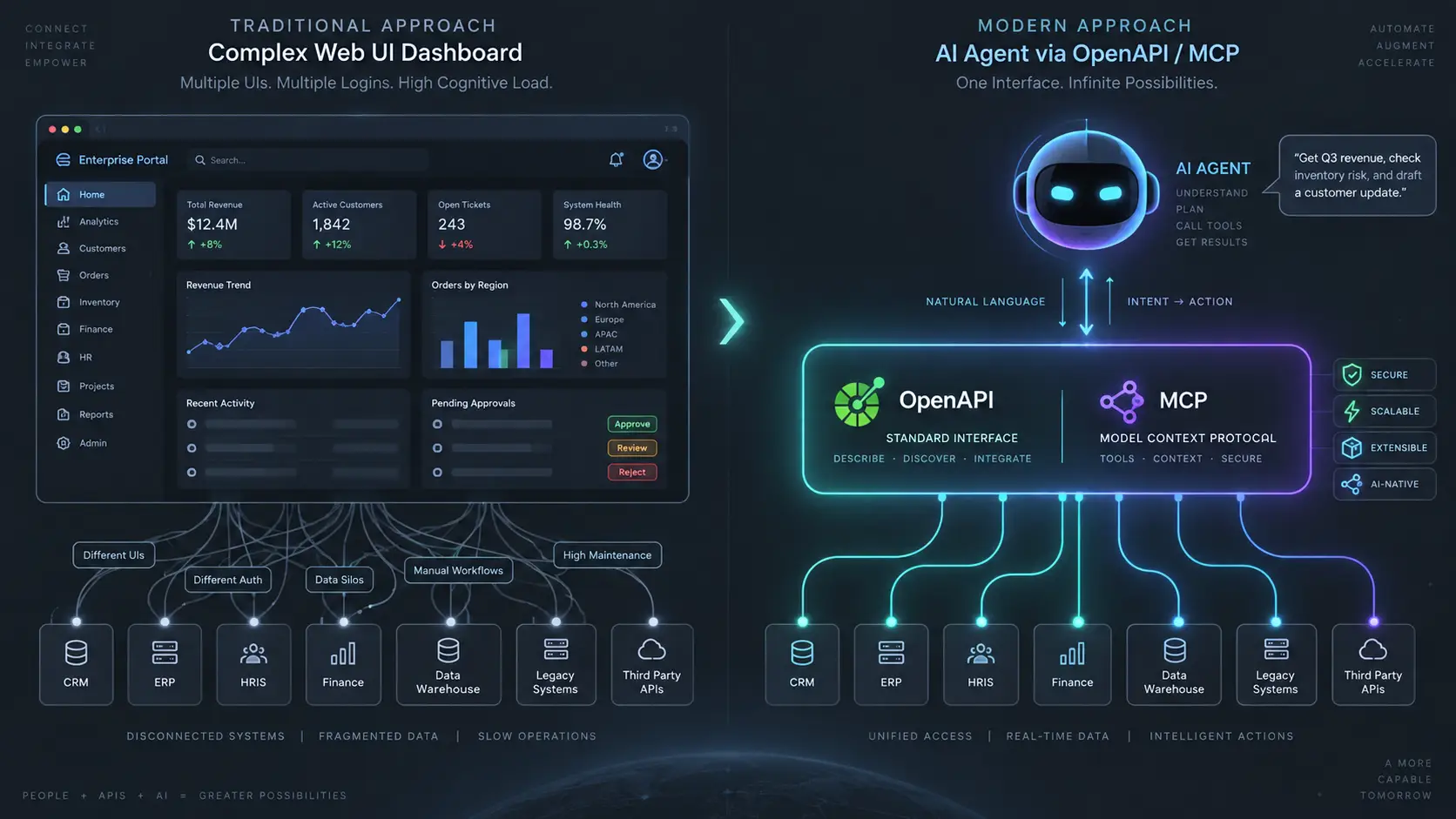
The Agent-Native API: Why OpenAPI & MCP Specs Are the New Enterprise UI
AI agents don't click through your web app — they call your endpoints. Here is why traditional REST APIs fail agents, and the four principles of an agent-native API layer.