
Your AI Chatbot Was Just the Beginning
If your company deployed a customer-facing chatbot or an internal AI assistant in 2024 or 2025, you are not alone. Nearly 97% of executives say their company deployed AI agents in the past year, according to Deloitte's 2026 State of AI in the Enterprise report.
But here is the uncomfortable truth: that single chatbot is already outdated.
The enterprise AI landscape has shifted decisively from generative AI to agentic AI, and specifically from single agents to multi-agent systems. Gartner documented a 1,445% surge in multi-agent system inquiries from Q1 2024 to Q2 2025. By the end of 2026, approximately 40% of enterprise applications will include task-specific AI agents, up from less than 5% in 2025. Vendors are racing to provide the operating layer for this.
The question is no longer whether to adopt AI. It is whether your AI architecture can actually run your operations.
What Multi-Agent AI Actually Looks Like in Practice
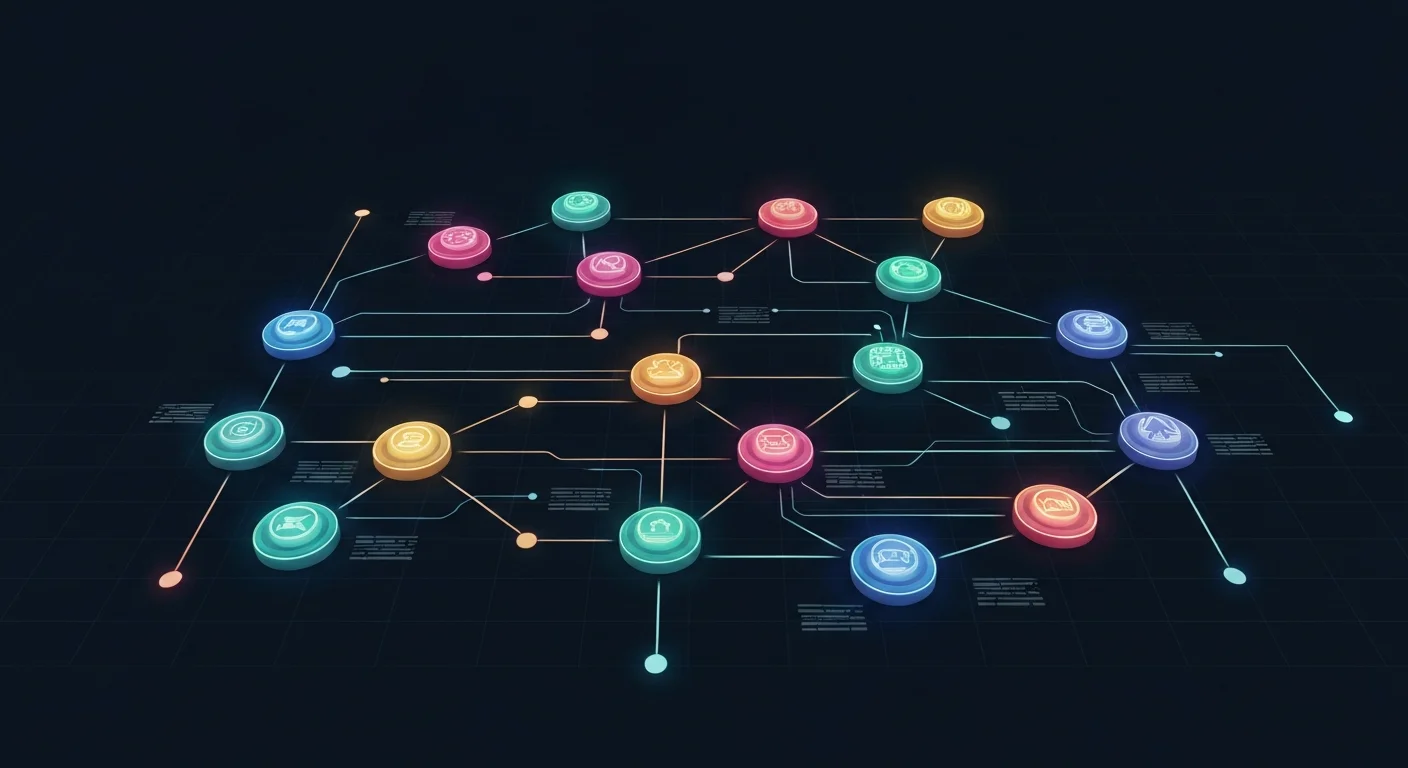
A multi-agent system is a coordinated network where specialized AI agents collaborate on complex workflows. Think of it as building a digital team rather than hiring a digital assistant.
Here is a concrete example. A mid-market insurance company processing claims might deploy four agents working in concert:
- Agent 1 (Intake): Reads incoming claim documents, extracts key data points, and normalizes them into a structured format
- Agent 2 (Validation): Cross-references extracted data against policy records, flags inconsistencies, and checks for fraud indicators
- Agent 3 (Decision): Applies underwriting rules, calculates payout amounts, and routes edge cases to human adjusters
- Agent 4 (Compliance): Audits every decision against regulatory requirements and generates documentation for regulatory filings
Each agent is purpose-built for its role. The system outperforms a single general-purpose model because specialization reduces error rates and enables parallel processing.
The numbers back this up: multi-agent AI systems deliver 3x faster task completion and 60% better accuracy compared to single-agent implementations.
The Three Frameworks You Need to Know
If you are evaluating multi-agent AI, three frameworks dominate the enterprise landscape in 2026. Understanding their strengths helps you make better build-vs-buy decisions.
LangGraph
LangGraph uses a graph-based workflow design that treats agent interactions as nodes in a directed graph. It is best suited for enterprises that need durable, auditable, long-running workflows with precise control over execution order and error recovery.
Best for: Financial services, healthcare, and any industry where audit trails and deterministic workflows are non-negotiable.
CrewAI
CrewAI adopts a role-based model inspired by real-world organizational structures. Agents are organized into "crews" with defined roles, goals, and collaboration patterns. It supports both code-based and no-code development.
Best for: Rapid prototyping and business teams that need to automate cross-functional workflows quickly. DocuSign used CrewAI agents to streamline lead data consolidation, and PwC improved code-generation accuracy using CrewAI's role-driven workflows.
Microsoft AutoGen
AutoGen orchestrates agents through structured dialogue rather than predefined workflows. Agents exchange messages, delegate tasks, and reach consensus through conversation.
Best for: Dynamic collaborative systems requiring real-time concurrency and human oversight, such as intelligent meeting facilitators and adaptive workflow engines.
The Hybrid Approach
In practice, many enterprises use a hybrid strategy: prototype with CrewAI for fast validation, then rewrite in LangGraph for production-grade reliability, embedding AutoGen's code execution capabilities where needed.
Where to Deploy Multi-Agent Systems First
Not every process needs a multi-agent system. Focus on workflows that are high-volume, multi-step, and currently require handoffs between teams or systems.
The industries showing the strongest results in 2026 are:
Financial Services: Loan processing, fraud detection, and compliance reporting. Multi-agent systems reduce processing time from days to hours while improving accuracy on regulatory checks.
Retail and CPG: Inventory optimization, dynamic pricing, and customer journey orchestration. Telecommunications leads adoption at 48%, followed by retail and CPG at 47%.
Healthcare: Patient intake, claims processing, and clinical documentation. Multi-agent systems handle the data extraction and validation that consumes 30-40% of administrative staff time.
Legal: Contract review, due diligence, and regulatory monitoring. Specialized agents can review documents faster than paralegals while flagging nuanced risk factors for attorney review.
The Governance Problem You Cannot Ignore
Here is what the hype cycle misses: 79% of organizations face challenges in adopting AI in 2026, a double-digit increase from 2025. More concerning, 54% of C-suite executives admit that adopting AI is "tearing their company apart."
Multi-agent systems amplify this challenge. When you have four agents making decisions in a pipeline, you need:
- Observability: The ability to trace every decision back to its source agent and input data
- Guardrails: Hard limits on what each agent can and cannot do, especially around financial transactions, PII handling, and customer communications
- Human-in-the-loop checkpoints: Defined escalation paths for edge cases and high-stakes decisions
- Version control: The ability to roll back individual agents without disrupting the entire system
Companies that skip governance will scale their mistakes as fast as they scale their operations.
A Practical Roadmap for Getting Started
If your organization is ready to move beyond single-agent AI, here is a realistic path forward:
Weeks 1-2: Identify the Right Workflow Map your highest-volume, multi-step processes. Look for workflows where errors are costly, handoffs are frequent, and human time is spent on repetitive validation rather than judgment.
Weeks 3-4: Design the Agent Architecture Define each agent's role, inputs, outputs, and decision boundaries. Do not start with the technology. Start with the workflow.
Weeks 5-8: Build a Focused Pilot Deploy 2-3 agents on a single workflow using CrewAI or a similar rapid-prototyping framework. Measure task completion time, accuracy, and exception rates against your current baseline.
Weeks 9-12: Add Governance and Observability Before scaling, implement logging, audit trails, and human-review checkpoints. This is where most pilots stall, and where most value is lost.
Months 4-6: Scale to Production Migrate to a production-grade framework like LangGraph. Integrate with existing enterprise systems. Train operations teams on monitoring and exception handling. For teams that want a shorter path to production, managed agent platforms promise to slash enterprise AI deployment from months to days.
The enterprises that will win in 2026 are not the ones with the most AI agents. They are the ones with the best-orchestrated agent systems, governed end-to-end and delivering measurable outcomes.
Move From Experimentation to Operations
Multi-agent AI is not a future trend. It is the current state of enterprise AI, with over $600 billion in investment and 40% of enterprise applications expected to include AI agents by year-end.
The gap between companies experimenting with chatbots and companies running coordinated agent operations is widening fast. Closing that gap requires architectural thinking, governance frameworks, and implementation expertise that most internal teams are still building.
At Cynked, we help businesses design, build, and govern multi-agent AI systems that deliver measurable ROI. Whether you are planning your first pilot or scaling from proof of concept to production, our team can accelerate your path from AI experimentation to AI operations.
Book a discovery call to discuss how multi-agent AI can transform your operations.
Need a scalable stack for your business?
Cynked designs cloud-first, modular architectures that grow with you.
Related Articles

AI Success Criteria Framework: Stop 41% of AI Failures
Forrester found 41% of AI failures stem from unclear success criteria. This pre-launch framework defines baselines, ROI thresholds, and kill criteria for 2026.

Only 12% of AI Agents Reach Production: What Winners Do
78% of enterprise AI agent pilots never scale. Here's the structural playbook the 12% who succeed are using to ship agents to production in 2026.

AI Data Readiness: The Gap Behind 88% of POC Failures
88% of enterprise AI pilots fail to scale due to poor data readiness. Learn the audit framework, metrics, and action plan CTOs use in 2026.