

The Promise Is Real. So Are the Pitfalls.
AI agents — systems that can pursue multi-step goals, make decisions, and take actions across software tools — are moving from research projects to production deployments in enterprise settings. The use cases are real: agents that can research and draft procurement contracts, process insurance claims end-to-end, qualify and route sales leads, or manage IT service tickets without human involvement at every step. For a broader survey of where agents are already delivering operational ROI, see our overview of how AI agents are automating business operations right now.
The technology is capable. The risks of poorly planned deployment are equally real. Managed platforms are making enterprise deployment faster than ever, and a wave of agent-native infrastructure is following. Speed does not remove the need for careful planning. Here is how to think about where to start and what to avoid.
What Makes a Good First Agent Use Case
Not every business process is a good candidate for agentic AI. The highest-success first deployments share a few characteristics:
High volume, low variability. Agents excel at processes that happen hundreds or thousands of times in a similar pattern. The more consistent the input and the more defined the expected output, the better.
Clear success criteria. You need to be able to measure whether the agent performed correctly. "Processed correctly" needs an operational definition — an output you can check against a standard.
Bounded consequence of error. Start in areas where a mistake is detectable and correctable before it causes significant harm. Back-office processing, internal tools, and draft-generation workflows are more forgiving than customer-facing actions or financial decisions.
Existing documentation. If the process is not written down anywhere, it is not ready for automation. Document the current process first. It will surface edge cases your agent design needs to handle.
High-Value Starting Points by Function
Finance and operations: Invoice processing, expense categorization, financial report drafting, vendor data reconciliation. These combine high volume with clear right/wrong criteria.
Sales and marketing: Lead research and enrichment, CRM data hygiene, first-draft proposal generation, meeting follow-up summaries. Agents augment the sales team without replacing relationship-building.
Customer support: Tier-1 ticket resolution, knowledge base search and response drafting, escalation routing. The agent handles the answerable questions; humans handle the nuanced ones.
HR and people operations: Job description drafting, candidate pre-screening Q&A, onboarding document processing, policy question answering. These are information-heavy workflows well-suited to agents.
Legal and compliance: Contract review against a checklist, regulatory change monitoring, risk flagging in documents. These require human sign-off on conclusions but benefit from AI to do the reading.
What to Avoid in Your First Deployment
High-stakes autonomous decisions without human review. Agents deciding on credit approvals, terminations, patient care, or major financial commitments without a human checkpoint. The technology is not the limitation — accountability and auditability require a human in the loop.
Processes with undefined exception handling. Every real-world process has edge cases. If your agent design does not specify what happens when input is ambiguous, data is missing, or the expected path is blocked, you will discover those gaps in production. Map your exception paths before deployment.
Replacing a human before the agent is proven. Redeploying staff is reasonable once a process is running reliably. But cutting headcount in anticipation of an agent that has not yet proven itself in production creates fragility. Pilot first.
Opaque agent decisions in regulated workflows. In healthcare, finance, and legal contexts, you may be required to explain why a decision was made. Build auditability in from the start — log what the agent did, what inputs it used, and why it chose a particular action.
The Governance Framework You Need Before You Start
Before your first agent goes to production, you need answers to these questions:
- Who owns the agent? Which team is responsible for monitoring performance, handling failures, and approving changes?
- What are the guardrails? What actions can the agent never take without explicit human approval?
- How will you detect errors? What monitoring is in place, and who gets alerted?
- What is the rollback plan? If the agent starts behaving unexpectedly, how quickly can you pause or revert it?
- How does this interact with regulation? Have you identified applicable compliance requirements?
This governance work is not bureaucracy for its own sake. It is the infrastructure that lets you expand agent use confidently — because you know how to detect problems and respond.
Starting with the right use case and the right governance framework makes the difference between an agent that delivers real business value and one that creates new problems to manage. If you are mapping your first enterprise agent deployment and want an experienced perspective on scope and risk, let us know. This is exactly the work we do with leadership teams before they commit to a build.
New to AI agents? FreeAcademy has a clear explainer on what AI agents are and how they work that covers the fundamentals before you start evaluating enterprise use cases.
Need a scalable stack for your business?
Cynked designs cloud-first, modular architectures that grow with you.
Related Articles

AI Agents Explained: What Business Owners Need to Know
AI agents are reshaping how businesses operate. Learn what they are, how they differ from chatbots, and whether your business is ready to adopt them.

How AI Agents Are Automating Business Operations Right Now
Discover how agentic AI is transforming business operations in 2026 with real use cases in customer support, supply chains, and workflow orchestration.
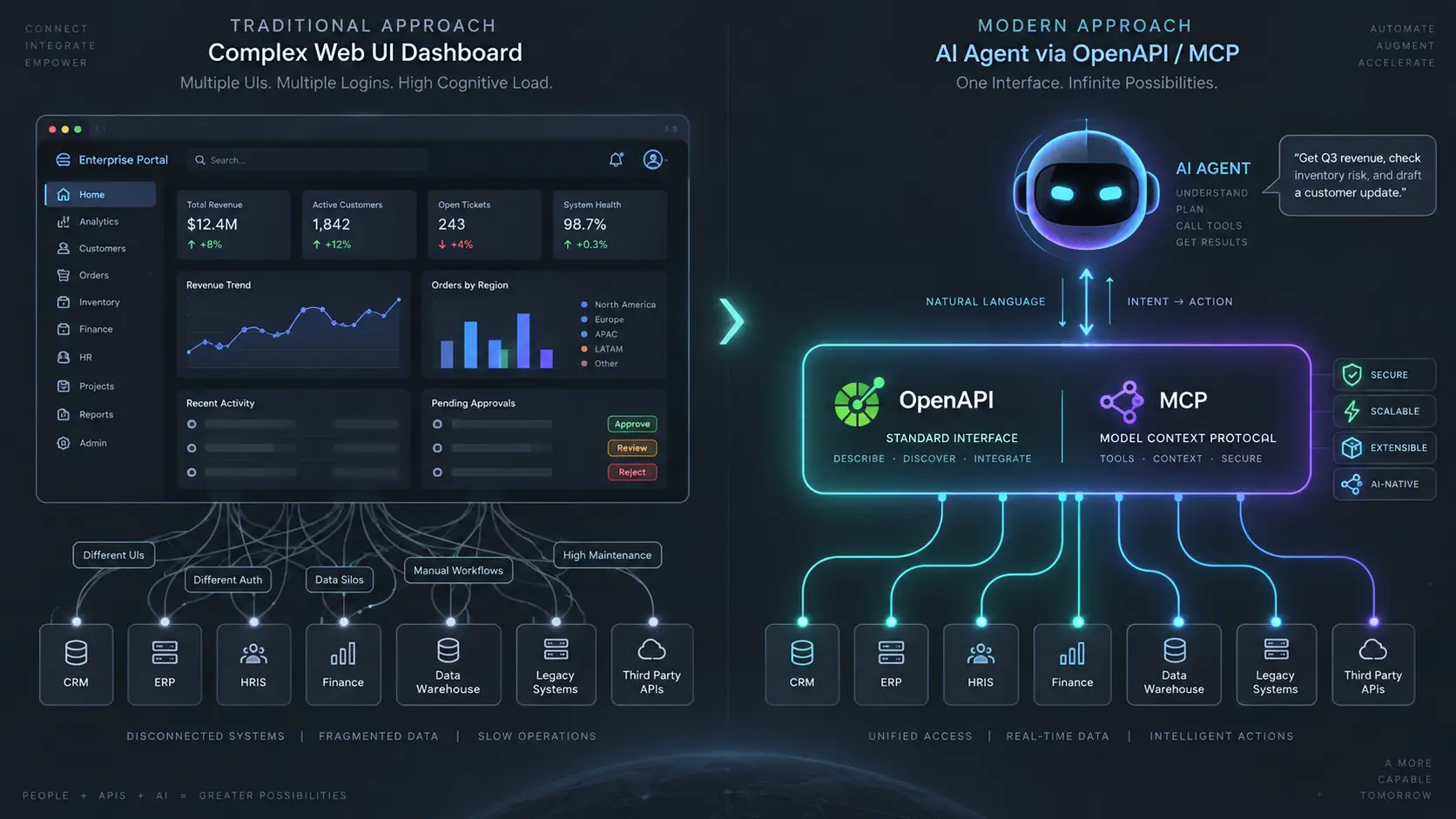
The Agent-Native API: Why OpenAPI & MCP Specs Are the New Enterprise UI
AI agents don't click through your web app — they call your endpoints. Here is why traditional REST APIs fail agents, and the four principles of an agent-native API layer.