
There is a quiet shift happening inside enterprise networks, and most leadership teams have not noticed it yet. The fastest-growing category of "users" on your systems is no longer people. It is software — specifically, AI agents that authenticate, make decisions, call APIs, and move data with minimal human oversight.
The numbers are striking. Security researchers now estimate there are 45 to 90 non-human identities for every human identity in a typical enterprise, and that ratio climbs with every new agent a team deploys. Meanwhile, 92% of organizations say they are not confident their existing identity and access management (IAM) tools can manage the risks that come with AI agents and non-human identities. Put those two facts together and you have a governance gap that is widening by the week.
For CTOs and CIOs, this is not a theoretical concern. It is the difference between an AI program that scales safely and one that becomes the subject of an incident report. The accountability gap is now a board-level issue, and identity governance sits squarely in the Chief AI Officer's remit.
Why AI agents break traditional identity models
Classic IAM was built for two kinds of actors. Humans log in, do predictable things, and log out. Service accounts run fixed scripts on a schedule. Both are governable because both are bounded.
AI agents are neither. An agent receives a goal, decides on its own which tools to invoke, chains those tools together, and may take actions the person who launched it never explicitly approved. It might read a CRM record, draft an email, query a database, and trigger a workflow in another system — all under a single credential, often a long-lived API key copied into a config file.
Three properties make this dangerous at scale:
- Autonomy. Unlike a script, an agent's behavior is not fully predictable in advance, so static permission reviews don't capture what it will actually do.
- Sprawl. Developers can stand up a new agent in minutes using a framework like LangChain, CrewAI, or a cloud agent runtime — usually without filing a ticket. The result mirrors the "shadow IT" problem, except the shadow actors have system access. The sprawl now extends beyond engineering teams: with agents able to write and publish website content directly, marketing and content teams are minting agent identities too. This blurs reporting lines fast, which is why companies are restructuring the org chart around agents before identity governance can catch up.
- Privilege creep. Because it's easier to grant broad access than to scope it tightly, agents accumulate "just in case" permissions. A 2026 industry analysis found persistent, over-broad access is the single biggest source of credential sprawl in agentic deployments.
The consequence is plain in the breach data: the security press has spent the first half of 2026 documenting incidents where attackers compromised an agent's token and used it to move laterally — because that token had standing access to far more than the agent's job required.
What good looks like: treat agents as first-class identities
The emerging consensus from bodies like the Coalition for Secure AI (CoSAI), which published architectural guidance on agentic identity in March 2026, and NIST, which opened an AI Agent Standards Initiative in February 2026, comes down to one principle: stop shoehorning agents into the "human" or "service account" buckets and give them a purpose-built identity lifecycle.
In practice, that means five concrete controls:
1. Inventory every agent
You cannot govern what you cannot see. Start with a census: how many agents exist, who owns each one, what credentials they hold, and what systems they can reach. Most organizations are shocked by the answer. This inventory becomes the backbone of every other control.
2. Issue short-lived, task-scoped credentials
Replace long-lived API keys with credentials that are minted for a specific task and expire automatically — minutes or hours, not months. Just-in-time elevation, where an agent requests a narrowly scoped token at the moment it needs it, eliminates the "god-mode" key sitting in a repo. Cloud-native secret managers, HSMs, and KMS services already support this; the work is in wiring agents to use them instead of hardcoded secrets.
3. Enforce least privilege per action, not per agent
Scope an agent's access to the minimum it needs for its current job, and re-evaluate when the job changes. An agent that summarizes support tickets does not need write access to billing. This is the same principle as zero-trust for humans — applied to the actor that is now far more numerous.
4. Tie every agent action back to a human decision
The audit question regulators and your own board will ask is: who authorized this? Build traceability so every consequential agent action links to the human who initiated the workflow, with a log that survives across systems. This is also what makes the EU AI Act's transparency and human-oversight expectations achievable rather than aspirational.
5. Manage the full lifecycle — including offboarding
Agents get created; they also get abandoned. A decommissioned pilot whose credentials still work is a live attack surface. Provisioning, credential rotation, monitoring, and clean deprovisioning need to be one managed process, owned by someone, not a collection of one-off scripts.
A 90-day starting plan
You don't need a platform replacement to make progress. A pragmatic sequence:
- Weeks 1–3: Run the agent inventory. Pull a list of API keys and service accounts created in the last 12 months, identify which belong to AI agents, and tag them by owner and blast radius.
- Weeks 4–8: Triage. Take the five highest-risk agents — the ones with broad data access or production write permissions — and migrate them to vaulted, short-lived credentials with scoped permissions. Add audit logging.
- Weeks 9–12: Set policy. Require every new agent to register, draw credentials from a central secrets manager, and carry an owner. Add an agent identity check to your existing access review cadence.
This is deliberately incremental. The goal in the first quarter is not perfection — it is to stop the bleeding and establish that agents are governed assets, not free-floating ones.
The bottom line for leadership
AI agents are delivering real value — the same 2026 enterprise surveys that flag the governance gap also report measurable productivity gains from agentic deployments, particularly in the AI super-user cohorts that are pulling away from the rest of the workforce. The risk is not the agents. The risk is deploying them faster than you can account for them. Identity is the control plane for agentic AI, and right now most organizations are flying without instruments.
If your company is scaling AI agents — or planning to in 2026 — and you're not confident you could answer "how many agents do we have, and what can each one touch?", that's the gap to close first.
Cynked helps businesses deploy AI agents and automation securely — from agent identity inventories and least-privilege architecture to governance frameworks your board can sign off on. Get in touch for a consultation on building an AI agent program that scales without becoming your next security incident.
Further reading from FreeAcademy: How to use AI agents in your daily workflow (2026 guide) gives leadership teams a practical view of the agentic workflows that drive non-human identity sprawl. For engineering leaders mapping a reskilling path into the AI agent space, the JavaScript to AI developer roadmap lays out the learning path from frontend work into building production AI agents.
Need a scalable stack for your business?
Cynked designs cloud-first, modular architectures that grow with you.
Related Articles
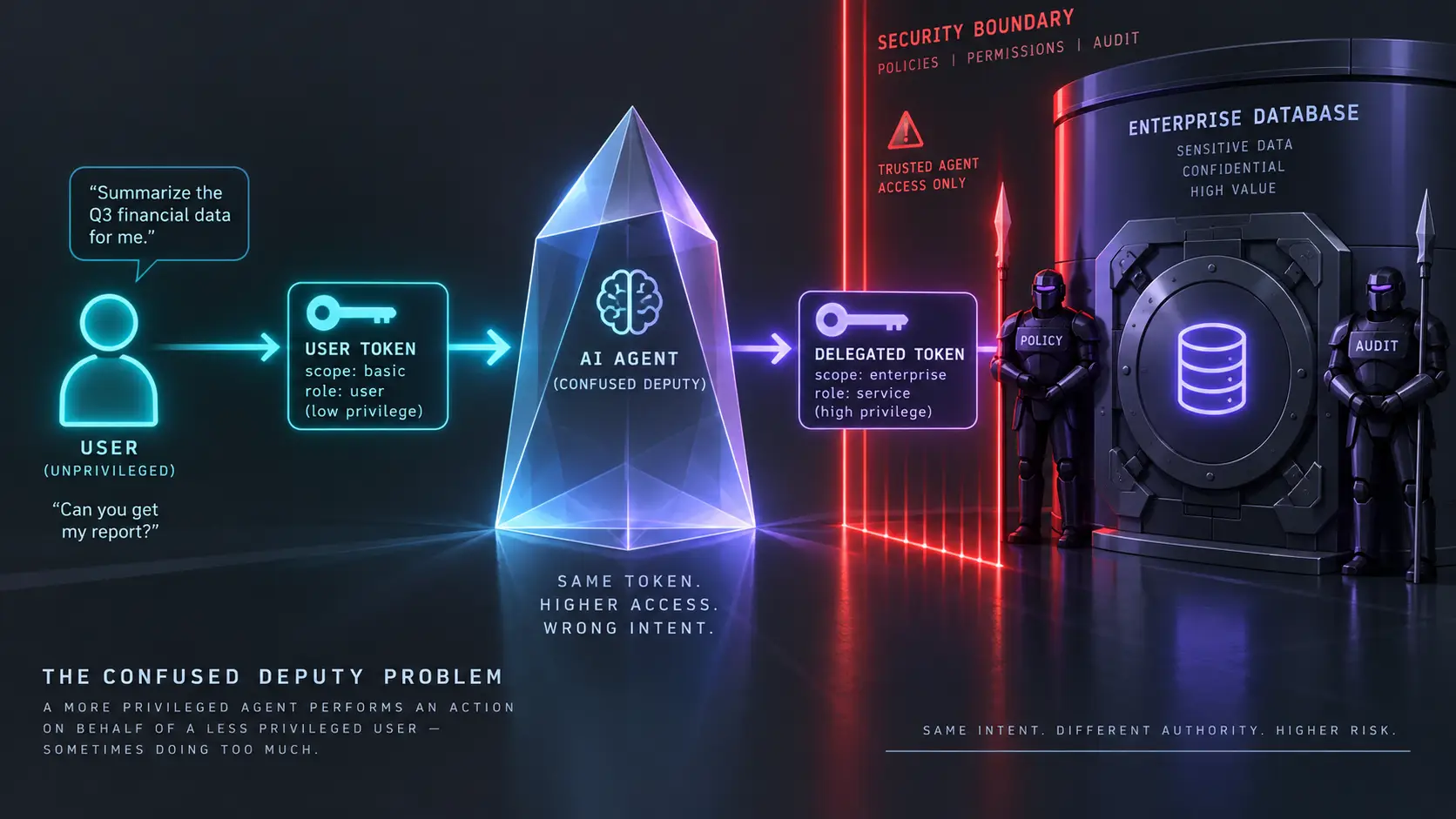
The Confused Deputy Problem in AI Agents: Why Ambient Authority Destroys Enterprise Security
An AI agent running on a master service key can be talked into fetching data its user is forbidden to see. Delegated, ephemeral, data-layer-bound authorization closes the gap that prompt guardrails can't.
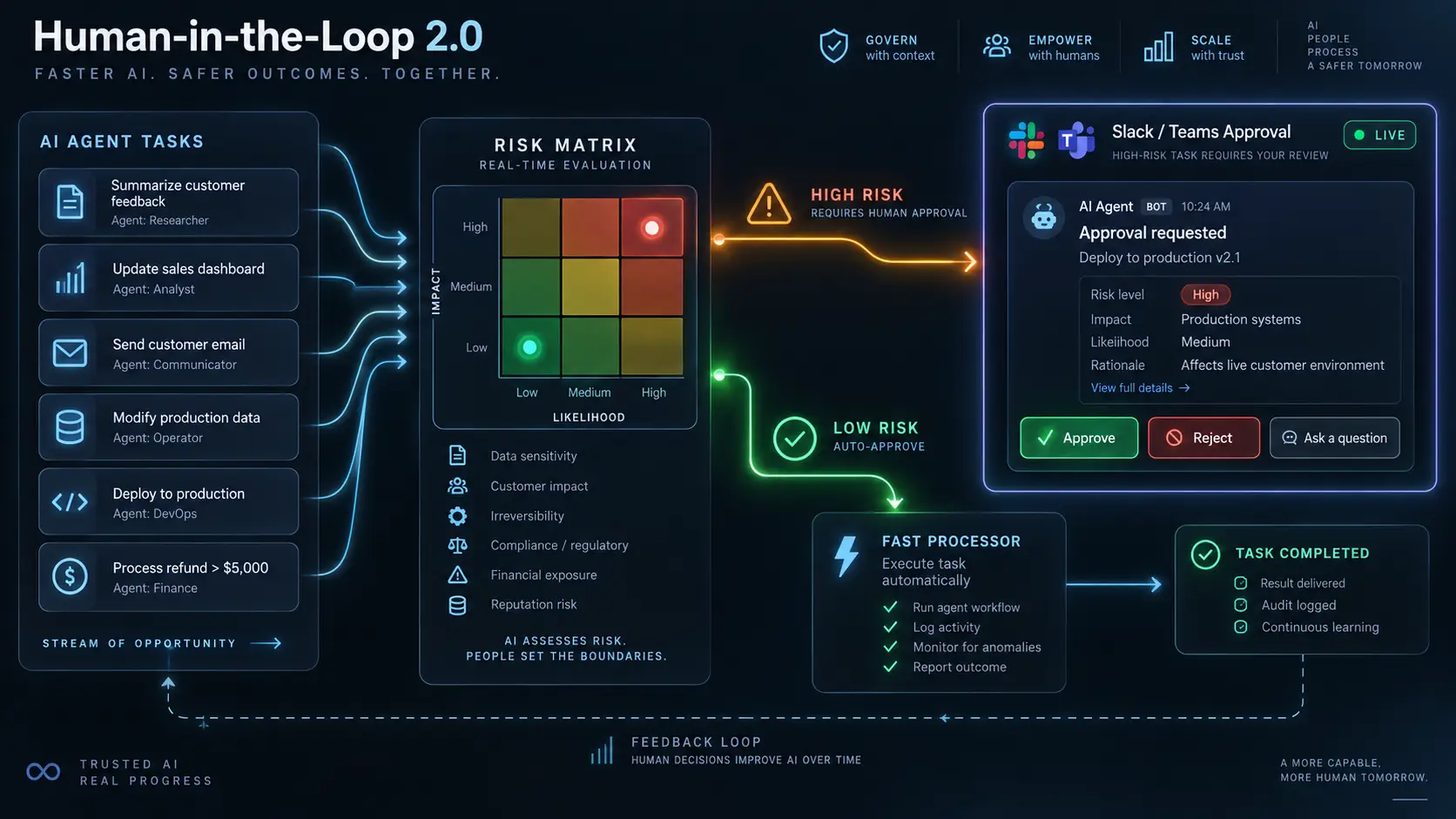
Human-in-the-Loop 2.0: Designing Escalation Triggers That Don't Bottleneck Agents
Requiring human approval for every agent action is not governance — it is a queue. Here is how risk scoring, confidence thresholds and async escalation keep agents fast and safe.

The AI Agent Containment Gap: Why You Can't Shut Down a Rogue Agent
60% of enterprises can't quickly shut down a misbehaving AI agent. Here's the four-primitive containment architecture that closes the gap before an incident.