

Enterprise AI spending in 2026 is at record levels, but the conversion rate from pilot to production has barely budged. The latest data is uncomfortable: 79% of organizations report challenges adopting AI despite higher investment, 88% of AI agent pilots never reach production, and just 23% of enterprises see significant ROI from agents.
Buried in those numbers is a single, dominant pattern that most boardroom conversations miss. According to recent surveys from S&P Global, Writer, and Deloitte's State of AI in the Enterprise, nearly 60% of AI leaders identify legacy system integration as their primary adoption challenge for advanced AI, and 46% rank it as the top obstacle to deployment overall.
It is not the model. It is not the prompt. It is the plumbing.
Why integration breaks agentic AI specifically
Traditional SaaS integration is a solved problem. You map fields, schedule a sync, and accept some lag. AI agents are different in three ways that turn legacy integration from an annoyance into a blocker:
- Frequency and concurrency. A sales agent that triages 4,000 inbound leads per day issues orders of magnitude more API calls than a nightly batch job. Many on-prem ERPs, mainframe gateways, and 15-year-old middleware were never load-tested for that traffic shape.
- Autonomy and blast radius. A misconfigured Zapier flow corrupts a row. A misconfigured agent can quietly issue 800 incorrect purchase orders before anyone notices. The integration layer is now also a safety layer.
- Schema fluidity. LLMs reason in natural language, not in your 1990s field codes. Every integration needs a translation tier that normalizes legacy schemas into something the agent can use predictably, and back again for writes.
This is why 22% of agent deployments report negative ROI at 12 months. The model works in the demo. Production traffic hits the integration layer, and the wheels come off.
The five integration patterns that actually work in 2026
Across successful enterprise agent deployments, five architectural choices keep showing up.
1. The tools service pattern. Instead of giving agents raw API credentials to Salesforce, NetSuite, or Workday, expose a curated catalog of operations — create_quote, lookup_account, refund_order — through a dedicated tools service. This is the pattern Anthropic, OpenAI, and most production agent frameworks have converged on via the Model Context Protocol (MCP) standard. Benefits: centralized auth, rate limiting, audit logging, and the ability to swap underlying systems without touching the agent.
2. Idempotency keys on every write. Agents retry. Networks fail. Without idempotency keys, you will eventually duplicate every write operation an agent makes. This is non-negotiable for any financial, inventory, or customer-facing system.
3. Read replicas and event streams instead of direct OLTP queries. Pointing agents at your production transactional database is a path to outages. Stand up a read replica or a CDC-fed event stream (Debezium, Kafka, or your cloud's managed equivalent) and let agents query that.
4. Human-in-the-loop checkpoints, configurable per risk tier. Low-risk reads run autonomously. Medium-risk writes (drafting a contract) require one-click approval. High-risk writes (issuing a refund over $5,000, sending an external email to a regulator) require explicit human sign-off. The integration layer enforces these tiers — not the prompt.
5. Non-human identity (NHI) governance. Each agent gets a scoped service identity, short-lived credentials, and entitlements reviewed quarterly the same way employee access is. Treating agents as a new identity class is no longer optional under most 2026 enterprise security frameworks.
A 90-day legacy integration audit
For most mid-market and enterprise teams, the highest-leverage move in the next quarter is not a new pilot. It is auditing the integration surface area for the agents you have already deployed or planned. Here is the framework we use with Cynked clients:
Weeks 1–2: Inventory the surface area. List every system an agent will touch: ERP, CRM, ticketing, HRIS, billing, knowledge base, file storage. For each, capture the integration mechanism (REST, SOAP, file drop, screen scrape), the auth model, and the rate limits.
Weeks 3–4: Score data readiness. For each system, score data quality on a 1–5 scale across completeness, freshness, consistency, and schema documentation. Anything below a 3 either gets remediated or quarantined out of the agent's access pattern.
Weeks 5–8: Build the tools layer. Stand up an MCP server or equivalent tools service. Migrate one high-value use case from direct API calls to the tools layer. Add idempotency, audit logging, and tiered approval.
Weeks 9–12: Production hardening. Load test the tools layer at 10x expected traffic. Add observability — every agent action should be traceable end to end. Run a tabletop incident exercise: what happens if the agent issues 500 wrong actions before being caught?
Teams that complete this audit typically see time-to-production drop from 9+ months to 4–5 months on subsequent use cases, because the integration foundation is reusable.
What this means for CTOs and CIOs
The enterprises winning with AI agents in 2026 are not the ones with the most sophisticated models. They are the ones who treated the integration layer as a first-class platform investment — staffed it, governed it, and reused it.
If your AI roadmap for the next two quarters is a list of model choices and use cases without a corresponding integration architecture plan, you are setting up your team to join the 88% that never reach production.
Working with Cynked
Cynked helps mid-market and enterprise teams design AI agent architectures that survive contact with real production systems. We have built MCP-based tools layers, run legacy integration audits, and helped CTOs scope realistic 90-day plans that get agents past pilot purgatory. If your organization is stuck between an exciting pilot and a stalled production rollout, contact us for a no-obligation integration readiness conversation.
Need a scalable stack for your business?
Cynked designs cloud-first, modular architectures that grow with you.
Related Articles
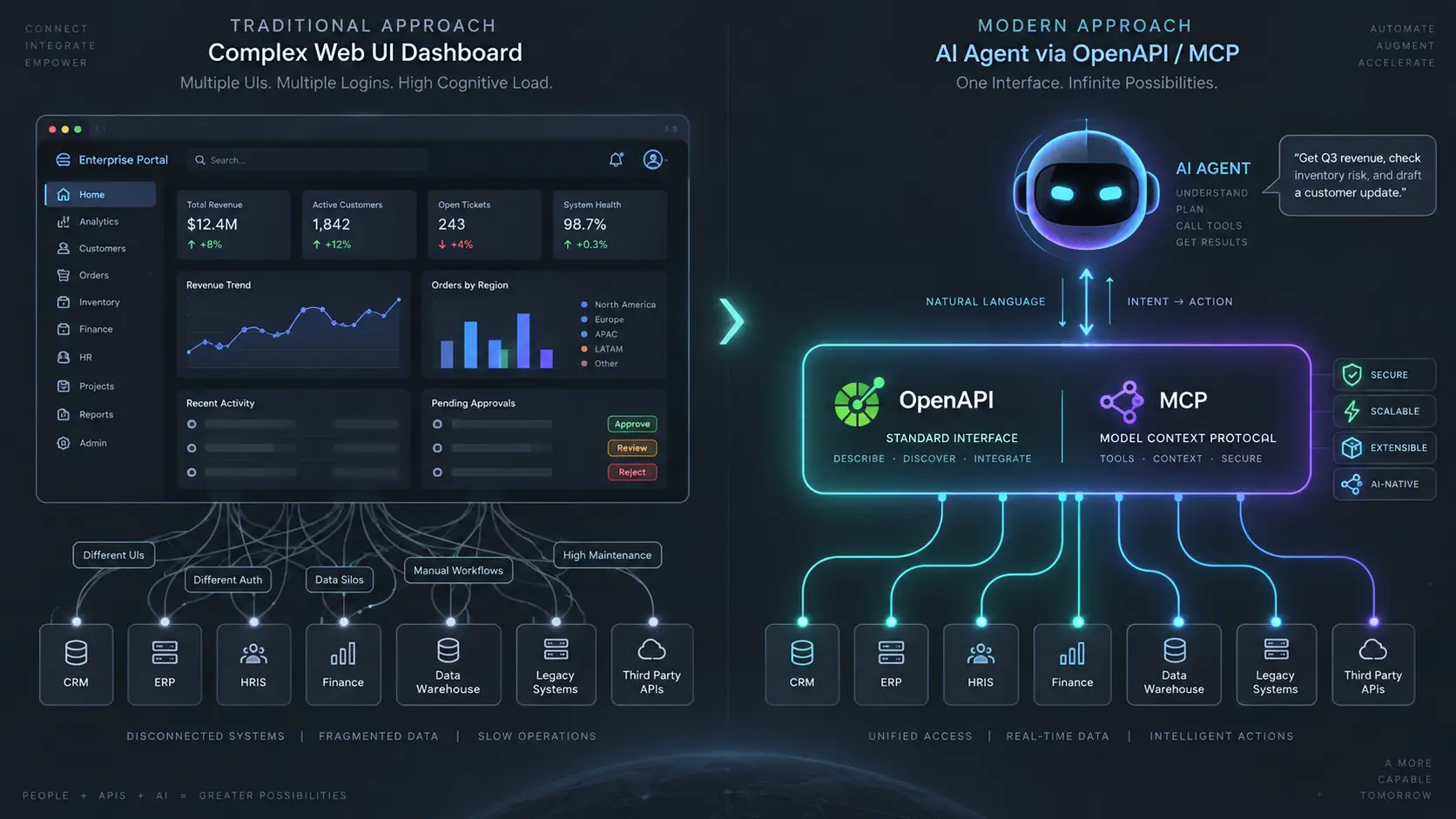
The Agent-Native API: Why OpenAPI & MCP Specs Are the New Enterprise UI
AI agents don't click through your web app — they call your endpoints. Here is why traditional REST APIs fail agents, and the four principles of an agent-native API layer.

7 AI Agents Every E-Commerce Business Should Deploy in 2026
Discover the seven AI agents delivering the highest ROI for e-commerce businesses in 2026 — from customer support to inventory forecasting and personalised recommendations.

How to Use AI Agents to Run Multiple Websites Without a Team
A real-world case study of running 6 websites with AI agents handling content publishing, SEO monitoring, email automation, and strategic planning. No employees, no freelancers. Here is how the system works.