
The Decision Every AI-Adopting Business Faces
You have decided to use a large language model for a business application. Maybe it is a customer-facing chatbot that needs to answer questions about your products. Maybe it is an internal tool that helps your team draft reports using company data. Maybe it is an agent that processes incoming requests using your standard operating procedures.
Whatever the use case, you will quickly arrive at a fundamental architectural decision: how do you get the AI to know your stuff? (If you are still working out which processes to target, start with our guide on how to identify which parts of your business are ready for AI.)
The model you are starting with — whether it is GPT-4, Claude, Gemini, or an open-source alternative — knows a lot about the world in general but nothing about your business in particular. It does not know your product catalogue, your return policy, your pricing structure, or how your operations team handles exceptions. You need to bridge that gap.
There are two primary approaches: Retrieval-Augmented Generation (RAG) and fine-tuning. They work differently, cost differently, and suit different use cases. Choosing the wrong one wastes time and money. Choosing the right one accelerates your path to a solution that actually works.
This guide explains both approaches in plain terms, compares them across the dimensions that matter for business decisions, and helps you determine which is right for your specific situation.
What Is RAG?
RAG stands for Retrieval-Augmented Generation. The concept is straightforward: instead of trying to bake all your knowledge into the AI model itself, you give the model access to your information at query time.
Here is how it works in practice. When a user asks a question, the system first searches your document repository — product manuals, knowledge bases, policy documents, FAQs, whatever is relevant — and retrieves the most relevant passages. Those passages are then included in the prompt sent to the language model, along with the user's question. The model generates its response based on both its general knowledge and the specific information retrieved from your documents.
Think of it as the difference between asking someone to memorise your entire employee handbook versus giving them a copy and saying "look up the answer." RAG is the latter approach.
How It Works Technically
- Your documents are split into chunks and converted into numerical representations (embeddings)
- These embeddings are stored in a vector database
- When a query comes in, it is also converted to an embedding
- The system finds the document chunks most similar to the query
- Those chunks are passed to the language model as context
- The model generates a response grounded in your specific documents
Key Characteristics
- No model modification. You use the language model as-is. Your knowledge lives in the retrieval system, not in the model.
- Real-time information. When you update a document, the next query reflects the change. There is no retraining needed.
- Transparent sourcing. You can show users exactly which documents informed the response, which builds trust and enables verification.
- Scalable knowledge. You can add thousands of documents without changing the model or the system architecture.
What Is Fine-Tuning?
Fine-tuning takes a different approach. Instead of giving the model information at query time, you train the model itself on your specific data so that it internalises your knowledge, tone, and reasoning patterns.
The process starts with a pre-trained language model — one that already understands language, reasoning, and general knowledge. You then continue training it on a curated dataset of examples that demonstrate the behaviour you want. These examples are typically input-output pairs: "Given this input, produce this output."
After fine-tuning, the model has absorbed the patterns from your examples. It responds differently than the base model — in ways that reflect your specific data, style, and requirements.
How It Works Technically
- You prepare a training dataset of high-quality input-output examples
- The pre-trained model is further trained on your dataset
- The model's internal weights are adjusted to reflect the patterns in your data
- The resulting model is deployed and generates responses based on its updated knowledge
Key Characteristics
- Model modification. The model itself changes. Your knowledge becomes part of its parameters.
- Behavioural consistency. Fine-tuning is excellent for teaching the model a consistent tone, format, or reasoning approach.
- Latency advantage. No retrieval step is needed at query time, which can make responses faster.
- Training investment. Every update to your knowledge requires retraining, which takes time and computational resources.
Head-to-Head Comparison
The right choice depends on your specific situation. Here is how the two approaches compare across the dimensions that matter most for business applications.
Data Requirements
RAG works with whatever documents you have. Product manuals, policy documents, FAQ pages, internal wikis — if it is text, it can be indexed. You do not need to restructure your data into a specific format. The barrier to entry is low.
Fine-tuning requires curated training examples in a specific format. You need hundreds to thousands of input-output pairs that demonstrate the exact behaviour you want. Creating this dataset is often the most time-consuming part of the process.
Verdict: If you have documents but not curated training data, start with RAG.
Cost
RAG has moderate upfront costs (building the retrieval pipeline and indexing your documents) and ongoing costs that scale with query volume (each query incurs retrieval and LLM inference costs). The infrastructure is relatively straightforward.
Fine-tuning has higher upfront costs (data preparation and training compute) and potentially lower per-query costs (no retrieval step, and fine-tuned smaller models can be cheaper to run than large models with RAG). However, each update requires retraining, which adds recurring costs.
Verdict: RAG is cheaper to start. Fine-tuning can be cheaper at scale if your knowledge does not change frequently.
Information Freshness
RAG excels here. Update a document, re-index it, and the next query reflects the change. For businesses with frequently changing information — pricing, inventory, policies, product specifications — this is critical.
Fine-tuning struggles with freshness. The model only knows what it was trained on. Updating its knowledge requires retraining, which can take hours or days depending on the dataset size and compute resources.
Verdict: If your information changes frequently, RAG is the clear winner.
Task Type
RAG is ideal for knowledge-intensive tasks where accuracy and grounding in specific documents matter. Question answering, customer support, research assistance, and document summarisation are natural fits.
Fine-tuning is ideal for tasks that require consistent behaviour, specific formatting, or domain-specific reasoning. Classification, structured data extraction, code generation in a specific framework, and maintaining a consistent brand voice are natural fits.
Verdict: Knowledge lookup favours RAG. Behaviour and style favour fine-tuning.
Accuracy and Hallucination
RAG reduces hallucination by grounding responses in retrieved documents. If the retrieval step finds the right information, the model is much less likely to fabricate an answer. However, if retrieval fails — the right document is not found or the query is ambiguous — the model may still hallucinate.
Fine-tuning can reduce hallucination within the model's trained domain but does not eliminate it. The model may still generate plausible but incorrect information, especially for questions at the edges of its training data.
Verdict: RAG provides better hallucination control because responses can be traced to source documents.
Interpretability
RAG is more interpretable. You can inspect which documents were retrieved and verify whether the response is consistent with the source material. This matters for compliance, auditing, and building user trust.
Fine-tuning is less interpretable. The model's knowledge is embedded in its weights, and it is difficult to determine why it produced a specific response. There is no "source document" to point to.
Verdict: If you need to explain or audit AI responses, RAG is strongly preferred.
Comparison Summary
| Dimension | RAG | Fine-Tuning |
|---|---|---|
| Data requirements | Documents in any format | Curated input-output pairs |
| Upfront cost | Moderate | Higher |
| Per-query cost | Higher (retrieval + inference) | Lower (inference only) |
| Information freshness | Excellent | Poor (requires retraining) |
| Best task type | Knowledge lookup, Q&A | Behaviour, style, classification |
| Hallucination control | Strong (traceable sources) | Moderate |
| Interpretability | High | Low |
| Time to production | Weeks | Weeks to months |
| Maintenance effort | Low (update documents) | High (retrain periodically) |
When to Use RAG
Choose RAG when:
- Your use case is primarily about answering questions or retrieving information from your documents
- Your information changes frequently and the AI needs to reflect those changes immediately
- You need to cite sources or provide evidence for responses
- You have a large volume of existing documents but limited curated training data
- Compliance or auditability requires knowing exactly what informed each response
- You want to get to production quickly with a minimum viable solution
Typical RAG Use Cases
- Customer support chatbots that answer questions from product documentation
- Internal knowledge assistants that help employees find information across company documents
- Legal or compliance tools that retrieve relevant policies and regulations
- Sales enablement tools that pull relevant case studies and product specifications
When to Use Fine-Tuning
Choose fine-tuning when:
- You need the AI to adopt a specific tone, format, or reasoning style consistently
- Your use case involves classification, extraction, or structured output rather than open-ended generation
- The knowledge the model needs is relatively stable and does not change frequently
- You have the resources to create and maintain a high-quality training dataset
- Query latency is critical and you cannot afford the retrieval step
- You want to use a smaller, cheaper model that performs as well as a larger model for your specific task
Typical Fine-Tuning Use Cases
- Email classification and routing based on your specific category taxonomy
- Report generation in a specific format with consistent structure and tone
- Domain-specific text analysis (medical, legal, financial) where general models lack precision
- Code generation within your specific technology stack and coding standards
When to Use Both
In many production systems, the answer is not RAG or fine-tuning — it is both. A hybrid approach uses fine-tuning for the behaviour layer (how the model responds) and RAG for the knowledge layer (what the model knows).
For example, you might fine-tune a model to follow your company's communication style and response format, then use RAG to provide it with the specific product information it needs to answer each query accurately. The fine-tuning ensures consistency and professionalism. The RAG ensures accuracy and freshness.
This hybrid approach is more complex to build and maintain, but it often delivers the best results for production business applications.
When a Hybrid Makes Sense
- High-volume customer-facing applications where both accuracy and brand consistency matter
- Applications where the model needs domain-specific reasoning AND access to frequently changing information
- Scenarios where you have invested in fine-tuning but find the model still needs access to specific documents for accuracy
Making the Decision
If you are still unsure, use this decision framework.
Start with RAG if:
- You have documents but not training data
- Your information changes regularly
- You need to be in production within weeks
- Traceability and source citation matter
Start with fine-tuning if:
- You have a well-curated dataset of examples
- The behaviour or style of responses matters more than the knowledge content
- You need a smaller, faster, cheaper model for a specific task
- Your domain knowledge is stable
Plan for both if:
- You are building a production system that will serve customers
- Both accuracy and brand consistency are non-negotiable
- You have the resources to maintain both the retrieval system and the training pipeline
In our experience working with mid-market businesses, roughly 70 percent of initial AI deployments are best served by RAG, 15 percent by fine-tuning, and 15 percent by a hybrid approach. RAG is the default starting point for most business use cases because it is faster to implement, easier to maintain, and provides better transparency.
How Cynked Can Help
Choosing between RAG and fine-tuning is one of the most consequential technical decisions in an AI project. The wrong choice does not just waste budget — it can set your project back months as you rebuild on the right architecture.
At Cynked, we help businesses make this decision with confidence. We assess your data, your use case, your team's capabilities, and your operational requirements to recommend the architecture that will deliver the best results with the least risk. Then we help you build it.
If you are evaluating AI approaches for a business application, book a discovery call with our team. We will help you cut through the technical jargon and make a decision grounded in your specific business reality.
Further reading: Deciding whether to build in-house or buy? FreeAcademy's breakdown of no-code AI tools vs coding your own AI app — which approach is right for you complements the architectural decision covered here. For team upskilling, see FreeAcademy vs freeCodeCamp: which free platform is right and the guide on how to choose the right online course for your goals. If you want AI systems to actually cite your business content in their responses, FreeAcademy's micro-course on making your content citable by AI is a practical next step, and the Google AdSense Mastery course is worth a look if your business model depends on content monetisation.
Need a scalable stack for your business?
Cynked designs cloud-first, modular architectures that grow with you.
Related Articles
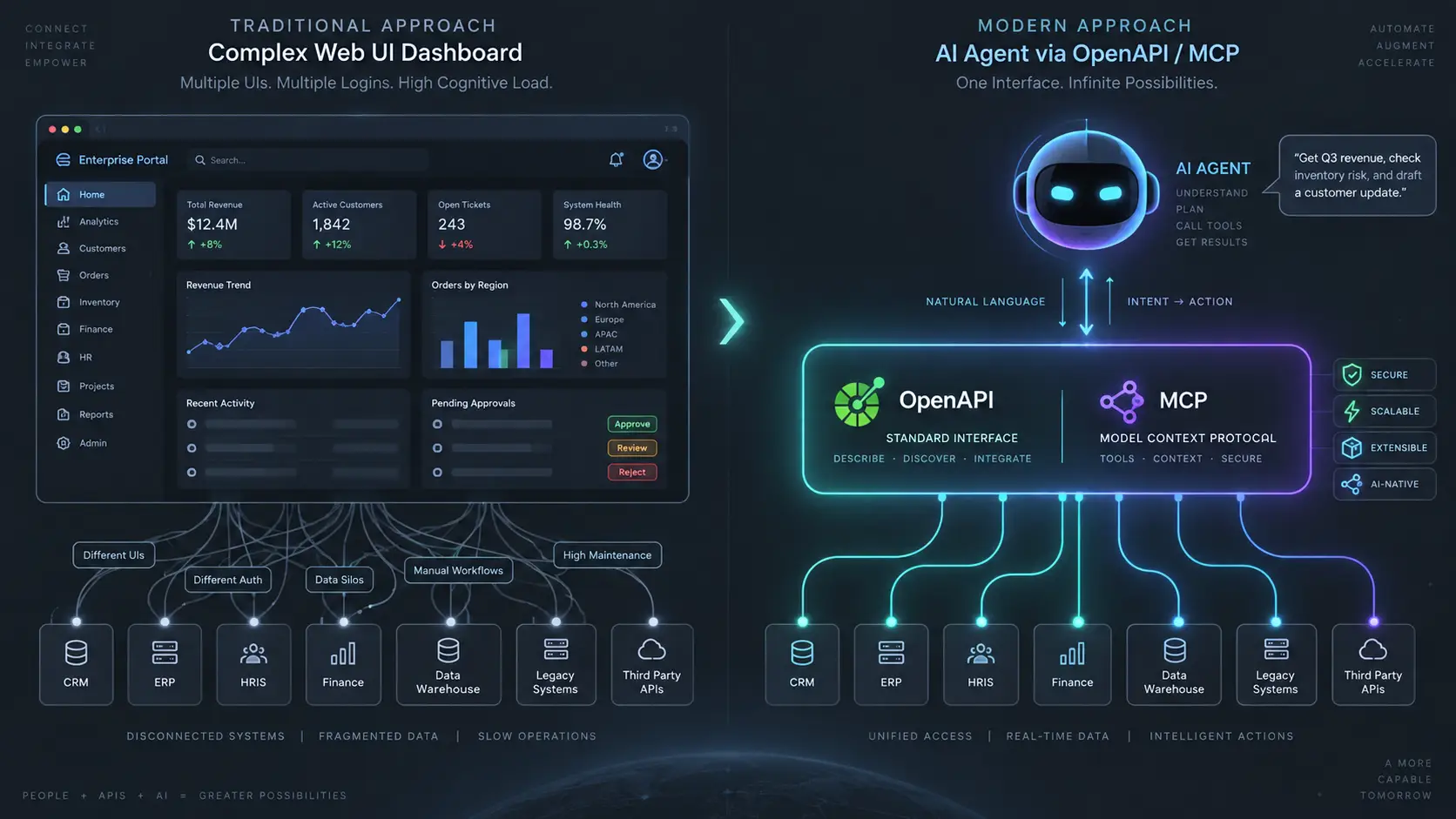
The Agent-Native API: Why OpenAPI & MCP Specs Are the New Enterprise UI
AI agents don't click through your web app — they call your endpoints. Here is why traditional REST APIs fail agents, and the four principles of an agent-native API layer.

AI in Healthcare Operations: Use Cases That Are Working Right Now
A practical look at AI use cases delivering real results in healthcare operations today — from patient intake automation to document processing and staff scheduling.
The 90-Day AI Adoption Roadmap for Mid-Market Companies
A practical 90-day AI adoption roadmap for mid-market companies. From initial assessment to live pilot — with milestones, team structures, and common pitfalls to avoid.