
Gartner dropped a number this quarter that should make every CIO pause before signing the next agentic AI contract: of the thousands of vendors marketing "AI agents" in 2026, only about 130 are building genuinely agentic systems. The rest? They are chatbots, RPA scripts, and workflow automations wearing a new logo. The industry has a name for it now — agent washing — and it is on track to cancel an estimated 40% of agentic AI projects by 2027.
If you are evaluating an agent platform this quarter, the difference between a real agent and a rebranded one is the difference between a six-figure productivity unlock and a six-figure write-off. Here is how to tell them apart before you sign.
Why agent washing exploded in 2026
Three forces collided. First, agentic AI became the headline category in every analyst report and board deck, with 78% of knowledge workers now using AI agents weekly. Second, enterprise budgets followed — Deloitte's 2026 State of AI in the Enterprise report shows 88% of organizations now use AI in at least one business function, with agent budgets growing the fastest. Third, no regulator or standards body has defined what an "AI agent" actually is.
The result is predictable. Any vendor with a chatbot, a Zapier-style workflow, or an RPA bot has a financial incentive to rebrand. The marketing change takes a week. The product change takes 18 months. Most vendors do the marketing.
For buyers, the cost is not just the wasted license. It is the lost year of internal momentum, the executive credibility burned defending the project, and the slow rebuild of trust with a CFO who already views AI spend with suspicion — especially when only 29% of executives report seeing significant organizational ROI from AI so far.
The 7-point evaluation framework
Use these seven questions in every demo. They are designed to fail rebranded products quickly so you can spend your evaluation cycles on the genuine ones.
1. Can it complete a multi-step task with zero intervention?
The definitional test. Ask the vendor to run a workflow that requires at least four steps across two systems — for example, "reconcile this invoice against our PO system, flag any discrepancies, draft a vendor email, and log the dispute in our ticketing tool." If the rep clicks, edits prompts, or hands off between steps, you are looking at a chatbot orchestrator, not an agent.
2. Does it plan, or does it follow a script?
Real agents generate a plan at runtime based on the goal and current state. Rebranded RPA executes a fixed sequence written by a developer. Ask: "What happens if step 3 fails? What if a new field appears in the source system?" A real agent re-plans. A scripted bot breaks or escalates to a human.
3. How does it handle tool calls and integrations today?
A "coming soon" integration list is the single biggest red flag in agentic AI procurement. Real agent platforms ship with working connectors to your stack — Salesforce, NetSuite, ServiceNow, Snowflake, Slack — and a documented MCP or function-calling layer for the rest. If you cannot make a real API call to your real systems during the POC, walk away. This red flag is so predictive because integration is where most rollouts actually stall — our breakdown of the legacy integration tax that stalls 60% of AI agents explains why. Hardware also matters: NVIDIA's NemoClaw launch at GTC 2026 is pushing local-first AI agents into reach for buyers with data-residency constraints.
4. Where does state live, and for how long?
Agents need memory: short-term working memory for a task, long-term memory for context across sessions. Ask to see the memory store, the retention policy, and how memory is scoped per user, team, and tenant. "It uses the LLM's context window" is not an answer — it is a confession that there is no agent.
5. What is the human-in-the-loop model?
Mature agents have configurable autonomy: full auto for low-risk steps, approval gates for high-risk ones (payments, customer messages, database writes), and a clean audit trail of every decision. If the only option is "agent does everything" or "human approves each step," the platform has not thought through enterprise deployment. Approval gates only cover the failures you anticipate; for the ones that slip through, ask what the undo path looks like — our AI agent rollback and recovery playbook lays out what a credible answer should include.
6. How are evaluations and regressions handled?
Production agents drift. Ask how the vendor measures task success rate, how they detect regressions when the underlying model is upgraded, and whether you get a test harness to evaluate the agent against your own data. Vendors who cannot answer this have not run an agent in production. For the framework we recommend buyers demand vendors implement, see our guide on how to test AI agents before they reach production.
7. What does the security and governance posture look like?
Data security, sovereignty, and compliance is the #1 cited barrier to AI strategy in 2026 (36% of executives, per Deloitte). Demand specifics: SOC 2 Type II, data residency options, role-based access control on tools and memory, prompt-injection defenses, and a clear policy on whether your data trains the underlying models. "We're working on it" disqualifies the vendor for any regulated industry.
A two-week POC structure that exposes agent washing
Most POCs are designed to flatter the vendor. Flip the script:
- Week 1, Days 1–2: Pick one workflow with measurable outcomes — e.g., "resolve tier-1 support tickets" with success defined as resolution rate, handle time, and CSAT. (If you run an online store, our roundup of the AI agents every e-commerce business should deploy is a useful shortlist of high-ROI workflows to start from; if customer service is your starting point, our 2026 guide to AI voice agents for customer service breaks down vendors and ROI benchmarks for exactly this use case.)
- Week 1, Days 3–5: Vendor connects the agent to your sandbox systems using only shipping integrations. No custom dev work allowed.
- Week 2, Days 1–3: Run 50 real (anonymized) tickets through the agent. Measure end-to-end success without intervention.
- Week 2, Days 4–5: Inject failure modes — a malformed input, an API timeout, a contradictory instruction. Watch how the agent recovers.
If a vendor cannot complete this POC in two weeks, you do not have a path to production with them. Plan for at least three vendors in parallel; the comparison is what kills agent-washed products — and it gives you leverage on price, which our playbook for negotiating AI agent pricing contracts shows how to use before you reach a term sheet.
The strategic takeaway
The agent category is real, and the productivity gains for enterprises that pick the right platform are large — Stanford's 2026 Enterprise AI Playbook documents successful deployments cutting cycle times 40–70% in finance ops, support, and sourcing. How quickly those gains land depends heavily on the use case; our AI agent time-to-ROI benchmarks map payback timelines from two-week customer-service wins to twelve-month supply-chain plays. And the biggest gains accrue to companies willing to reshape how they work around agents rather than bolt them on — our look at how smart companies are restructuring their org charts around AI agents shows what that structural advantage looks like. But the median experience in 2026 is going to be a canceled project, a frustrated CFO, and an 18-month delay before the second attempt.
The filter above is what separates the winners from the cautionary tales. Run it on every vendor. Be ruthless. The vendors building real agents will pass it easily — and they will be relieved that someone is finally asking.
Need help running this evaluation?
Cynked helps mid-market and enterprise teams design agent evaluations, run structured POCs, and pick platforms that survive contact with production. If you are about to commit budget to an agent platform and want a second opinion before you sign, contact our team for a 30-minute review of your vendor shortlist.
Further reading: Once your shortlist is real, the next questions are technical and architectural. FreeAcademy's deep dive on agentic RAG: how AI agents supercharge retrieval in 2026 explains the retrieval architecture genuine agents tend to ship with, and their guide on how to evaluate AI agents: metrics, benchmarks and testing in 2026 gives you a measurement framework you can demand vendors implement during POC. For practical context on what real agentic workflows look like in production, see how to use AI agents in your daily workflow (2026 guide). If your shortlist includes coding agents, the comparison of Claude Code vs OpenClaw: which AI coding agent should you use in 2026 and the explainer on what is OpenClaw — the open-source AI agent taking over 2026 are useful primers before signing. For executives still building their own intuition, AI for beginners: 10 core concepts to understand before you start (2026) is a quick grounding before vendor demos, and LangChain functions, tools, and agents: practical guide 2026 explains the framework that genuinely agentic vendors should be able to discuss in detail.
Need a scalable stack for your business?
Cynked designs cloud-first, modular architectures that grow with you.
Related Articles

How to Test AI Agents Before They Reach Production (2026)
Quality is the #1 barrier to AI agent deployment in 2026. Learn how to build evaluation pipelines, pick the right evals platform, and ship agents that actually work.

Your Wrist Is Smarter Than You Think: AI on the Galaxy Watch 8 Classic
Galaxy AI and Google Gemini are built into the Samsung Galaxy Watch 8 Classic, but most owners barely scratch the surface. Here is what is live now, what One UI 9 Watch adds, and how to actually use it.
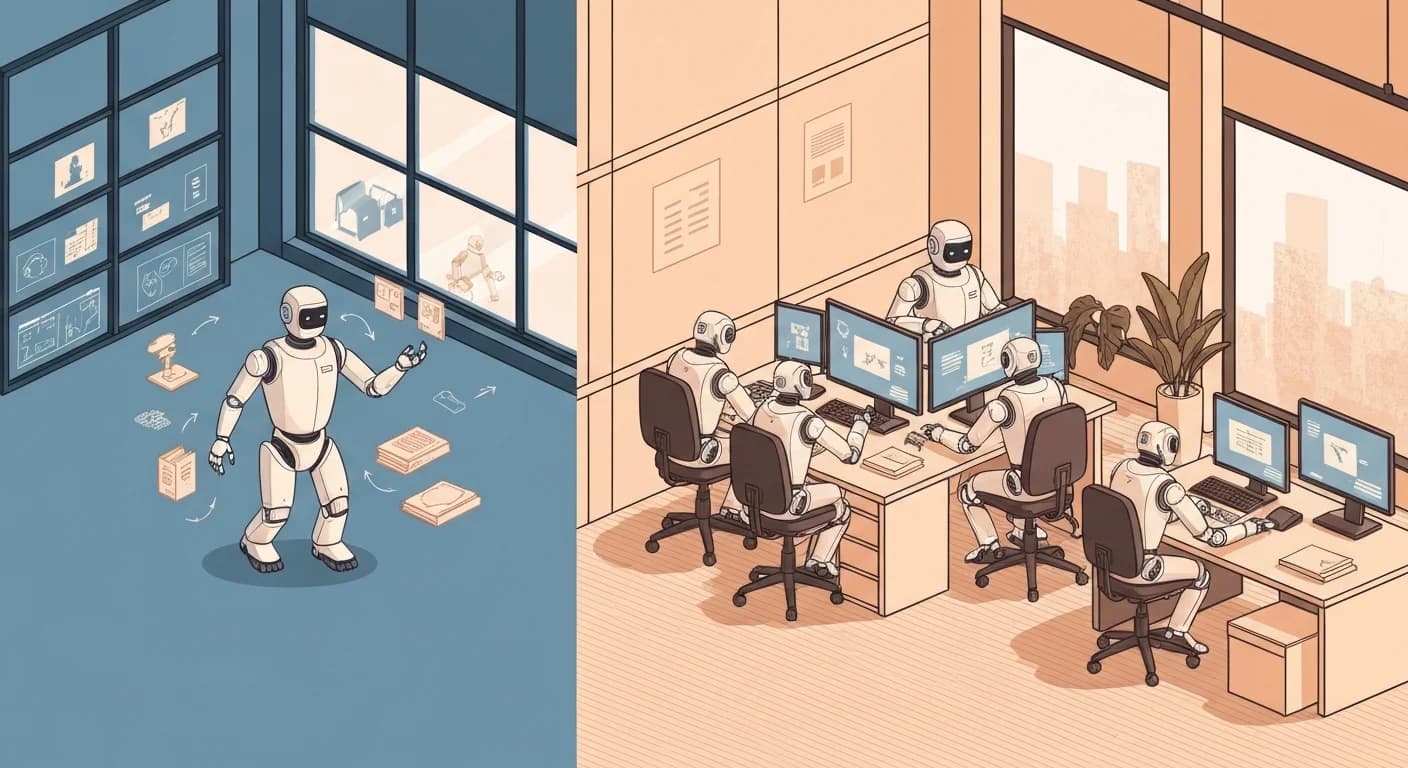
Vertical AI Agents Deliver 500% ROI: A Buyer's Guide for 2026
Vertical AI agents return ~500% ROI vs ~171% for horizontal tools. Learn when to pick specialized agents, how to evaluate vendors, and avoid costly mistakes.