

In April 2026, Gartner released a striking finding: artificial intelligence projects in infrastructure and operations are stalling ahead of meaningful ROI returns. Combined with the firm's earlier prediction that over 40% of agentic AI projects will be cancelled by 2027, the message to enterprise leaders is clear: deployment is not the same as delivery.
If your organization is among the 86% planning to increase AI spend this year, you need to know where the bottleneck lives. Spoiler: it is not in the model. It is in operations.
The Numbers Behind the Stall
Recent enterprise AI research paints a sobering picture:
- 89% of enterprise AI agents never reach production (Stanford AI Index 2026)
- Only 29% of executives report significant organizational ROI, even though 97% claim some benefit
- Average implementation cost runs $150K to $800K per project with zero return when projects do not ship
- 49% of organizations remain stuck in early-stage pilots
The pattern is consistent: the technology works, the budget exists, but the path from pilot to production breaks down somewhere in the middle.
Where Projects Actually Die
In our consulting work with mid-market and enterprise clients, the same five operational gaps surface again and again.
1. Production-Readiness Gaps in Data Pipelines
Pilots run on hand-curated datasets. Production needs continuous, governed, monitored data flows. Many teams discover too late that their data pipelines were never engineered to support real-time AI workloads — and rebuilding them adds four to six months.
2. Missing AgentOps and Observability Tooling
You would not run a microservice in production without logging, tracing, and alerting. AI agents need the equivalent: input and output capture, drift detection, cost-per-task monitoring, and rollback paths. Most teams attempt to bolt these on after the agent ships — which slows production approval indefinitely.
3. Security and Compliance Sign-Off
In 2026 enterprise surveys, 36% of leaders cite data security and compliance as the single greatest barrier to advancing AI strategy. Pilots routinely skip security review because they touch synthetic or sandboxed data. The moment a pilot needs production data, InfoSec restarts the clock.
4. The Last-Mile Integration Problem
The model output works. The chatbot answers. But the answer needs to write to Salesforce, trigger a workflow in ServiceNow, and update a record in NetSuite. That last-mile integration is where many pilots silently fail — not because it is hard, but because no one budgeted for it.
5. Change Management and User Adoption
Tools sit unused. Recent enterprise data shows adoption inside large companies is wildly uneven, with super-users getting five to ten times more value than the median employee. If your KPI is "users enabled" rather than "users active," your project is already at risk.
The 2026 Playbook: Five Moves to Avoid the Stall
1. Pre-Stage the Production Path Before the Pilot Ends
Define what production looks like — pipelines, security review, integration points, rollback — before the pilot kickoff. Reverse-engineer your pilot scope to match production constraints from day one.
2. Run Pilots on Production-Like Data
Synthetic data masks the operational gaps that actually kill projects. Use anonymized production data through proper data-access controls, even if it slows the pilot start by two weeks. You will save two to six months on the back end.
3. Build or Buy AgentOps From Day One
Tools like LangSmith, Arize Phoenix, Helicone, and Galileo provide observability for LLM-driven systems. Pick one before you ship — not after. Add a cost-per-task budget alert before the agent goes live.
4. Make Security and Legal a Sponsor, Not a Gate
The fastest production paths we see come from clients who put a security stakeholder on the steering committee from kickoff. They are not the ones giving approval at the end — they are shaping the architecture from the start.
5. Define Adoption Metrics That Matter
Replace "% of users enabled" with "% of users completing five or more AI-assisted tasks per week." Tie a portion of the budget to adoption outcomes, not seat counts. Run weekly office hours during the first 60 days post-launch.
A Concrete Example: 90 Days From Pilot to Production
A mid-market financial services client had spent eight months on an AI underwriting assistant pilot that worked in demos but never shipped. Three issues stalled it: data pipelines were not production-grade, security had not reviewed the LLM provider, and there was no integration with the underwriting case management system.
We restructured the project in three 30-day sprints:
- Days 1 to 30: Production data pipeline rebuild and security architecture review, in parallel
- Days 31 to 60: AgentOps tooling (Arize) and last-mile integration with the case management system
- Days 61 to 90: Pilot with 12 underwriters, daily adoption coaching, weekly KPI review
By day 90, the agent was processing 38% of routine underwriting decisions with human review. Twelve months in, projected annualized savings reached $2.4M. The technology had been ready since day one of the pilot. Operations was the bottleneck.
What CTOs and CIOs Should Do This Quarter
If you have AI pilots in flight right now, run a one-hour audit against this checklist:
- Has the production data pipeline been engineered, not just stubbed?
- Is observability tooling chosen and budgeted?
- Has InfoSec reviewed the architecture, not just the data?
- Are last-mile integrations scoped and resourced?
- Is the adoption metric outcome-based, not enablement-based?
If you are answering no to two or more, your project is on a path to becoming part of Gartner's 40%.
How Cynked Helps
At Cynked, we work with CTOs, CIOs, and operations leaders to close the gap between AI pilot and production ROI. We bring deployment expertise — not just model expertise — to enterprise AI initiatives. Our 90-day production sprint methodology has helped clients in financial services, healthcare operations, and retail logistics ship agents that actually run.
If your AI projects are stalling, we should talk. Contact Cynked for a free AI operations audit, and we will help you identify the specific bottleneck killing your ROI before it kills your budget.
Need a scalable stack for your business?
Cynked designs cloud-first, modular architectures that grow with you.
Related Articles
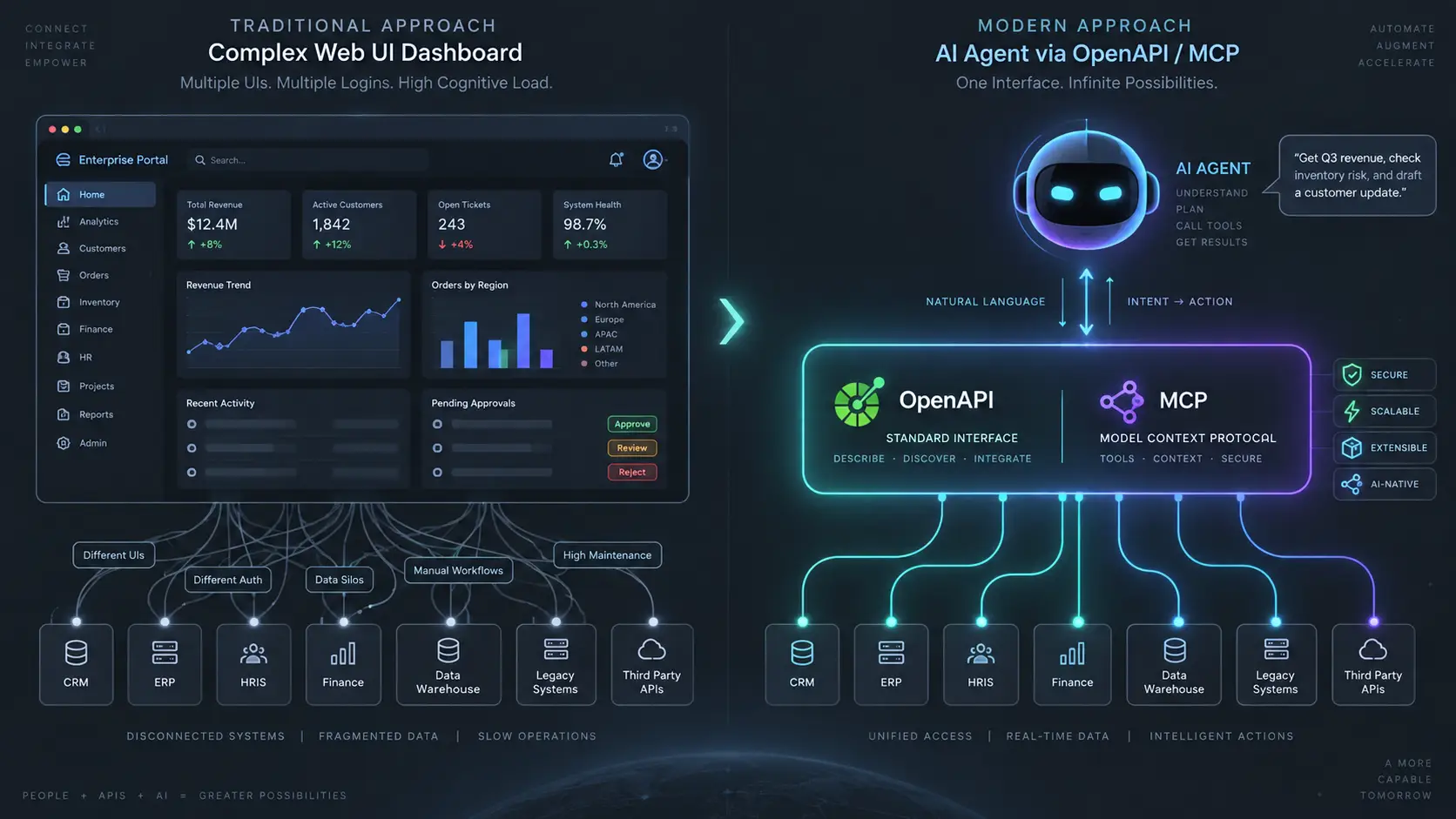
The Agent-Native API: Why OpenAPI & MCP Specs Are the New Enterprise UI
AI agents don't click through your web app — they call your endpoints. Here is why traditional REST APIs fail agents, and the four principles of an agent-native API layer.

Big Tech Is Cutting Jobs While Betting Billions on AI Infrastructure
Oracle laid off 30,000 workers while investing billions in AI data centers. Here's what this labor-versus-infrastructure shift means for your business strategy.

AI Agents in the Enterprise: Where to Start and What to Avoid
AI agents can automate complex multi-step workflows — but deployed in the wrong place, they create new problems. Here is a practical framework for enterprise leaders deciding where to start.