
It's Thursday afternoon. An email arrives from a supplier you've used for two years. Same name, same signature, same friendly tone. They've changed banks, and here's the updated account for this month's invoice. The grammar is perfect. The amount is right. Nothing about it feels wrong.
That's the problem. For years, the advice was to look for spelling mistakes, clumsy phrasing and strange greetings. AI has taken those away. (The scenario is an illustration of a common pattern, not a client story.)
What the numbers say
The FBI's Internet Crime Complaint Center received more than one million complaints in 2025, with reported losses of $20.877 billion, according to Help Net Security's summary of the report. For the first time, the report gave AI its own section: more than 22,000 complaints linked to AI, with nearly $893 million in losses, and more than $30 million lost by businesses to AI-related email scams.
Those are only the cases people reported. And they are US figures, but the tricks travel: the same tools write just as convincingly in Greek, German or Vietnamese.
Why "spot the mistakes" no longer works
AI helps scammers in three ways that matter to a small office:
- The writing is clean. No typos, the right tone, even your supplier's usual sign-off, copied from an old email.
- It's personal. Names, job titles and recent projects can be pulled from your website and LinkedIn and dropped into the message.
- Voices can be copied. In May 2025 the FBI warned that criminals were sending AI-generated voice messages impersonating senior US officials, and that a cloned voice can sound nearly identical to the real person.
So the defence can't be "I'd notice". It has to be a habit that works even when you don't notice.
The one rule that stops most of it
Money never moves on a message alone.
If an email, text or voice note asks you to change bank details, pay something urgently, or buy gift cards, the next step is always the same: call the person back on a number you already had or looked up yourself. Not the number in the email. Not a reply to the message.
This is the FBI's own advice: verify the identity of whoever is contacting you, then "independently identify a phone number for the person and call to verify". It costs two minutes. It works whether or not the email looks perfect.
Four more habits for a small office
1. Two people for new bank details. Any change to a supplier's account is checked by a second person before the next payment. In a two-person business, that's the other person. On your own, it's the call-back plus a 24-hour wait.
2. A family-style code word. Agree a word with the people who can ask you for money: your partner, your bookkeeper, your office manager. If a "boss" calls in a panic asking for a transfer, ask for the word.
3. Urgency is a warning sign. "Before 5pm", "the auditor is waiting", "keep this between us". Real suppliers can wait an hour. Make it normal in your business to slow down when someone pushes.
4. Look closely at the address, not the name. The display name can say anything. Scammers often use slight differences in email addresses, phone numbers and links. Hover or tap to see the real address before you trust it.
And your own use of AI
Using AI safely is the other half of this. A few rules worth writing down:
- Business accounts, not personal ones. Staff using AI through their own free accounts means company data sits somewhere you can't see or control.
- Nothing that unlocks money goes in. No bank logins, card numbers or passwords, ever, in any AI tool.
- AI drafts, a person sends. Especially anything that mentions payments, account numbers or deadlines.
- Know where client data goes. If you can't say which account it sits in and who can see it, don't put it there.
If it has already happened
- Call your bank immediately and ask them to stop or recall the payment. Hours matter.
- Report it to the police (in the US, also to the FBI at ic3.gov).
- Secure the email account the scam came through or was aimed at: change the password and turn on two-step sign-in.
- Keep everything: emails, numbers, messages. Don't delete the evidence.
None of this is legal or professional security advice, and it doesn't replace proper IT security. It's the set of office habits that would have stopped the Thursday afternoon email.
Put it on one page
Print the rule and the four habits and stick them next to whoever pays the bills. If you'd like help writing your business's AI rules (which tools, which accounts, what never goes in, who checks what), that's part of our AI Check-up: a 60-minute call and a one-page plan.
Not sure where AI would save your business time?
A 60-minute call and a one-page plan naming the 3 jobs in your business worth automating first. Taken off the price of any build booked within 30 days.
Related Articles
Does Your Website Chatbot Have to Say It's AI? Yes. Here's the Wording.
Since 2 August 2026, EU rules say people must be told when they're talking to an AI. What that means for a small business with a chat widget or an AI phone line, who is responsible, and short wording you can paste in today.

A One-Page AI Policy for a Small Team (Copy It, Then Change It)
Your staff are probably already using ChatGPT, Gemini or Claude for work, often on personal accounts. A short, plain AI policy a small business can copy today, what each line is for, and what the EU AI Act's 'AI literacy' rule actually asks of a small firm.
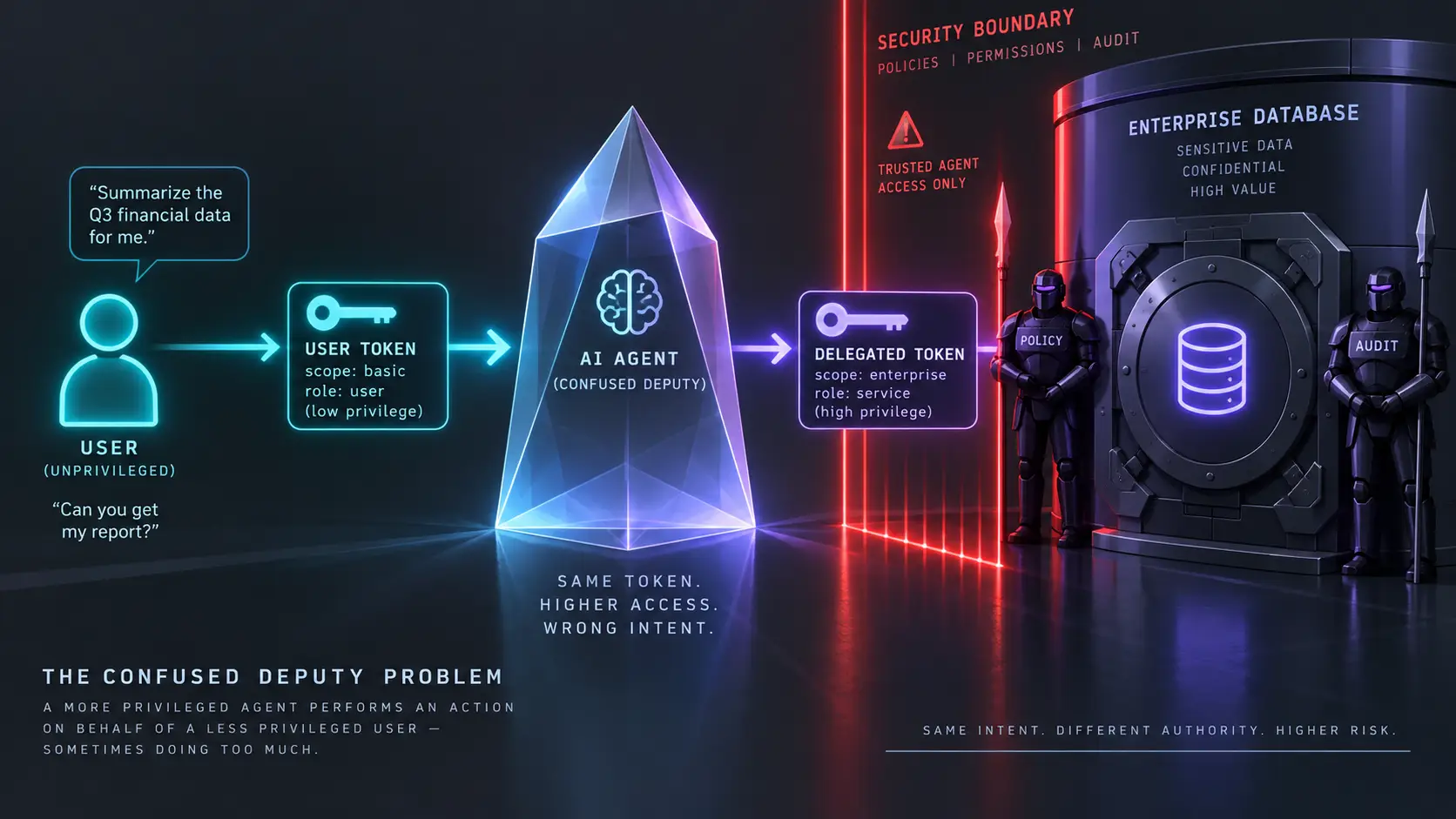
The Confused Deputy Problem in AI Agents: Why Ambient Authority Destroys Enterprise Security
An AI agent running on a master service key can be talked into fetching data its user is forbidden to see. Delegated, ephemeral, data-layer-bound authorization closes the gap that prompt guardrails can't.